



LAS VEGAS (KTNV) — Mail ballots are still trickling in from the 2026 election, but the lessons from a very blue night are coming into focus. Here are 13 takeaways from the 2026 general election.
1. The blue mega-tsunami
It started on the East Coast and swept across the country. From Maine to the Carolinas to the Midwest to Texas — and maybe to Alaska and even Mississippi — Democrats won races in states that President Trump carried, some by double digits.
RELATED | Democratic leaders outline agenda after sweeping Congress in midterms
This was obviously no ordinary election, exceeding the hopes of even the most optimistic Democrat. The Senate will have at least 54, and perhaps as many as 56 Democratic members. In the House, Democrats erased the thin Republican majority to win at least 254 seats. Current Speaker Mike Johnson announced he would not lead the Republican caucus in the minority, while retaining his Louisiana seat.
In Nevada, the wave swept Democrats into every statewide office and every congressional seat as well (more on that below). The Democratic majority in the Assembly was strengthened to as many as 32 seats, depending on the returns in one especially close Assembly race (more on that below, too).
WATCH | 13 takeaways from the 2026 election
2. Trump both on, and not on, the ballot
President Trump campaigned across the country in rallies, asking voters to pretend that he was on the ballot. Democrats took him up on the offer, pointing to high costs of living, especially gasoline and groceries, which they tied to Trump's war in Iran and tariff regime.
Ironically enough, Trump pledged on the campaign trail in 2024 to bring down costs and to eschew foreign wars; breaking those promises alienated some of his core supporters.
Trump's appeal has always been singular, however, and the loyalty voters show to him doesn't always translate to other candidates. That's true even when Trump handpicks and endorses the candidates, such as Ken Paxton in Texas and Darlene Graham in South Carolina.
Trump at various points mocked the Democrats' focus on "affordability" and touted the wealth of oil companies and the revenue from tariffs. Even when he dangled the promise of $5,000 checks to every adult U.S. citizen should the GOP retain control of Congress, he joked that the money could only purchase a hamburger and "perhaps a small dessert" at his Mar-a-Lago resort in Florida.
But Trump may not be wrong when he contended that, had he been at the top of the ticket, things could have turned out differently. For one, presidential elections always see higher turnout than midterm contests. For another, Trump attracts loyalists who will vote only for him.
The dimensions of the blue wave, however, suggest that even Trump may not have been able to overcome the voter anger in some of the states that turned blue.
3. A night of firsts
Across the country, and here in Nevada, candidates made history. Abdul El-Sayed became the first Muslim senator with his victory in Maine. Former Biden administration Interior Secretary Deb Haaland became the first Native American woman to be elected governor, winning in New Mexico. Former Atlanta Mayor Keisha Lance Bottoms became the first black woman governor in Georgia. And U.S. Rep. Chris Pappas won election to the Senate in New Hampshire, becoming the first openly gay male senator.
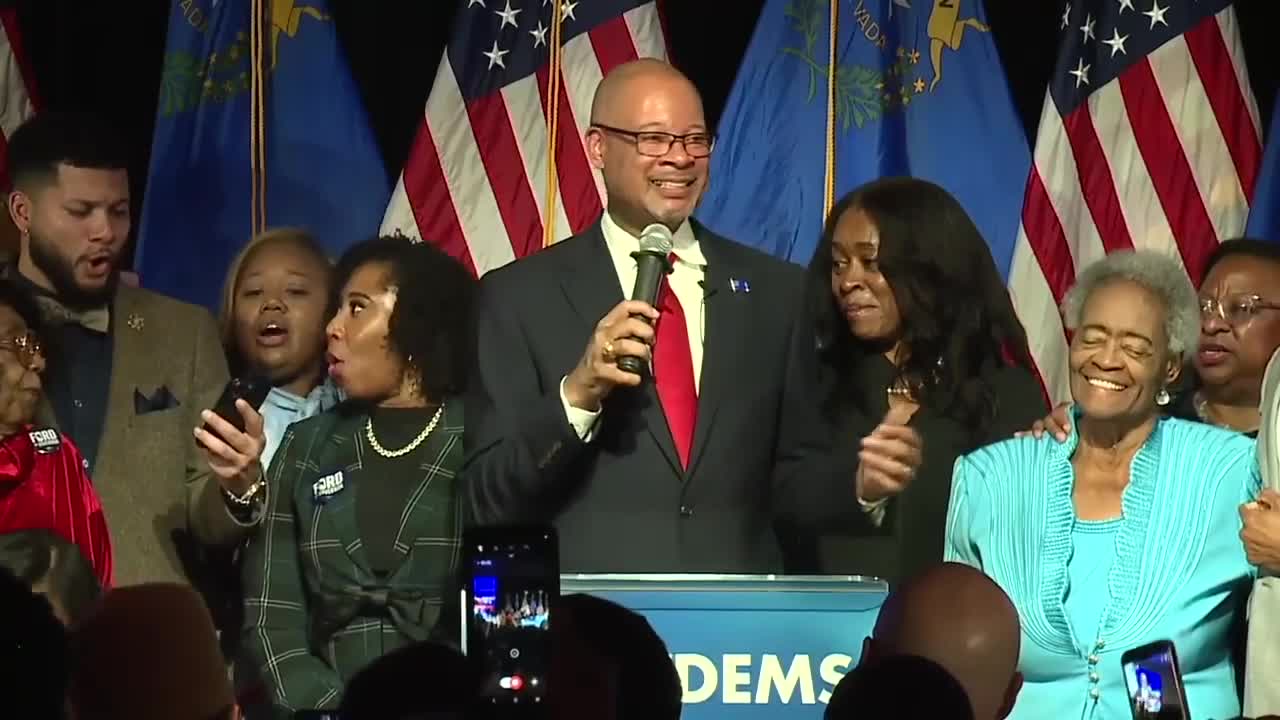
Here in Nevada, Attorney General Aaron Ford became the first Black governor in Nevada history. And Tya Mathis-Coleman, elected Nevada treasurer, became the first Black woman to hold statewide office in Nevada.
WATCH | Aaron Ford holds victory rally in east Las Vegas after winning Nevada governor's race
Up in the Second Congressional District, former Assembly Majority Leader Teresa Benitez-Thompson became the first woman, the first Latina and the first Democrat to hold the seat since it was created in 1981.
RELATED | Tracking races and results in Nevada's 2026 Midterm Election
That was all the more remarkable because Benitez-Thompson overcame a 13-point Republican registration advantage to win the seat.
4. Speaking of the Second District...
Another takeaway from the Second District: Nevada, especially Northern Nevada, does not like carpetbaggers.
Republican David Flippo, a retired Air Force lieutenant colonel, was initially planning to run in the 4th District against Democratic incumbent Congressman Steven Horsford. But when 2nd District Republican incumbent Mark Amodei announced he would not seek re-election, Flippo moved north to try to succeed Amodei.
RELATED | Democratic incumbents Dina Titus, Susie Lee, Steven Horsford hold on to US House seats
There was a bitter primary in which Flippo defeated former state Sen. James Settelmeyer, a rancher who served in the administration of Gov. Joe Lombardo. Many longtime Northern Republicans looked askance at Flippo's campaign after he won, 47% to 35%.
Benitez-Thompson was considered a long shot, given the district's lopsided Republican registration and the fact that a Democrat had never won the seat. But after Amodei — who endorsed Settelmeyer — refused to back Flippo, and Flippo was accused of misleading voters about parts of his military service, national Democrats suddenly viewed the race as winnable.
Benetiz-Thompson currently leads by more than 18,000 votes. Independent American Party candidate Lynn Chapman garnered 17,000 votes in the race.
5. Some outcomes were inevitable
The Second District may have surprised some pundits, but, in hindsight, the outcome in other races appears to have been inevitable.
Gov. Joe Lombardo threaded a careful course with respect to President Trump, at one point calling him his "commander in chief," while in another instance suing the Trump administration over its cuts to Nevada's Colorado River allocation, which the governor called unfair.
Lombardo appeared with Trump last at a rally at the Red Rock hotel-casino in August, when Lombardo in an impromptu appearance at Trump's podium suggested that billionaires needed protection lest they not provide jobs for working people.
Ford's campaign constantly tied Lombardo to Trump, calling it "the Lombardo-Trump" economy so often, listeners could be forgiven for thinking the governor's name was actually hyphenated.
But if Lombardo had done what Ford suggested — and confronted the president aggressively over tariffs and higher gas prices that had outsize effects on Nevada tourism — Trump would likely have retaliated, the way he did against former North Carolia Republican Sen. Thom Tillis or Louisiana Sen. Bill Cassidy.
Tillis chose not to run for re-election and Cassidy lost his seat to a Trump-backed primary challenger.
Lombardo would undoubtedly have faced the same fate had he challenged Trump.
On the other hand, a full-throated embrace of the president — whose approval rating hovers in the mid- to high-30% range — would have helped seal his fate as well, and played directly into the Democratic campaign against him.
In the end, Lombardo tried to thread the needle, avoiding confrontation and relentlessly focusing on Nevada issues such as education funding, affordable housing and the like. But no matter what he did, it seems the governor was doomed to be swamped by the blue wave on Tuesday.
6. Turnout lags, even for a midterm
As of Friday, more than 1 million votes had been recorded, which works out to about 52% of the 2.1 million active registered voters in the state.
Most of the ballots — more than 577,000 — were cast by mail, either returned through the U.S. postal service or dropped off at an election center.
More than 308,000 voted early, during the two weeks of early voting in late October.
And another 200,000 voted in person on Election Day — including more than 146,000 here in Clark County.
But average total turnout for a mid-term election over the last quarter-century is 56.3%. In the last midterm, 2022, it was 54.7%.
7. Long lines at the polls
Election Day voting in Clark County was delayed until almost midnight, as voters faced long lines at polling places around the valley.
Popular voting sites, including the Galleria Mall in Henderson, Las Vegas City Hall and the Desert Breeze Community Center, faced long lines that stretched for hours.
RELATED | Clark County processing thousands of mail ballots as officials address long Election Day lines
In part, it was due to an exceptionally long ballot, with 92 total races including 60 judicial contests for state and local judges, 16 of which were contested. There were also two ballot questions, constitutional amendments on abortion rights and voter ID.
The long ballot — the mail-in version required two cards — led to some delays in voting. The final votes cast as the clock approached midnight.
Clark County Registrar of Voters Lorena Portillo said at a post-election news conference that they county would evaluate its staffing and allocation of voting machines in anticipation of the next election.
Secretary of State Cisco Aguilar pledged in a news release that the state would help Clark County improve the process.
“Voters in Nevada deserve credit for their dedication during this General Election. They showed up despite the chaos the federal administration tried to incite in the months leading up to the election, and they overcame serious challenges on Election Day. That dedication is worthy of commendation, but no voter should have to wait in line for five hours," Aguilar said in the statement.
“Nevadans deserve better, and my team is ready to support Clark County officials and officials from any county willing to take ownership and confront these issues head on.
“The modernized election system we implemented gives us significantly more insight into county processes and voter activity than we have ever had before. We’ve been pouring over the data since last night to better understand what happened and will readily share what we learn with counties to help them ensure it doesn’t happen again.”
8. The Democratic playbook still works
For decades in Nevada, Democrats have managed to win statewide by winning big in Clark County, and keeping the numbers close in Washoe County.
Often, those are the only two counties on the map that are blue.
That held this cycle, as numbers show an overall Democratic advantage of about 37,000 votes statewide, primarily in Clark County, where there were more than 83,000 Democratic ballots than Republicans, according to figures from the secretary of state's office.
In Washoe County, Democrats outpolled Republicans by about 3,500 votes.
That Democratic advantage boosted every statewide candidate to victory, and helped upset a handful of seats in the Assembly.
9. Every vote counts
In every election, there are close races.
Some contests in Nevada come down to just a few votes, and occasionally, they result in a tie. In Nevada, that's sometimes decided by a high-card draw.
That happened to Clark County employee Tanya Flanagan in 2011 in a North Las Vegas City Council race. Tied with 328 votes each, Flanagan and rival Linda Meisenheimer drew cards, with Meisenheimer drawing the king of diamonds and Flanagan drawing the five of diamonds.
But Flanagan later served a term in the state Assembly and this year was handily elected as Clark County recorder.
Other races were farther apart, but still close.
For example, Assemblywoman Melissa Woodbury, R-Clark County, was trailing her Democratic opponent Shenea Booth by just 80 votes on Friday evening. (It was as close as seven votes right after Election Day.)
And Las Vegas City Council Ward 2 hopeful Luke McCarthy was trailing Shannon Nordstrom by just 139 votes.
10. Balance of power... but just barely
In the state Legislature, Democrats have dominated, thanks to redistricting that gives the party an advantage. That didn't change with Tuesday's election.
The state Senate remained exactly the same, 13 Democrats to eight Republicans, just one vote shy of a supermajority needed to override a gubernatorial veto or raise taxes. That gives every Republican member incredible influence when it becomes time to make deals.
In the Assembly, however, Democrats gained at least four seats, and perhaps five, if Booth's lead over Woodbury holds.
That means Democrats can easily muster a two-thirds vote (and even have room to lose a handful of votes) should that become necessary.
Lombardo said before his initial run in 2022 that "single-party rule" was not good for the state, since it obviates the need for compromise. In the Legislature, however, a single party now controls the Senate and the Assembly, as well as the governor's mansion.
Only a single vote in the state Senate blocks a complete Democratic supermajority, and true single-party rule.
11. Independents don't win
In the race for Clark County Commission District F, former state Sen. Becky Harris mounted a bid as an independent candidate.
It made sense; the district has more registered nonpartisans than any other in the county, and Harris had high name recognition from her term in the state Senate and her tenure as the first woman to be chair of the state Gaming Control Board.
But in the end, Harris ended up polling at just 7.5%, losing to both Democrat Minja Yan, who got 54%, and Republican former Assemblywoman Heidi Kasama, who earned 38%.
The outcome is similar to the fate of one-time Assembly candidate Daniel Hofstein, who ran in 2018 for the District 35 seat as a nonpartisan. That district, too, had the highest number of nonpartisan voters in the state.
But on Election Day, Hofstein earned just 10% of the vote, trailing behind eventual Democratic winner Michelle Gorelow and Republican David Schoen.
Part of the reason is that most nonpartisan voters lean either toward Democrats or Republicans. And many nonpartisans are registered at the DMV automatically, but never intend to actually cast a vote in an election.
12. Edgar Flores' redemption tour
State Sen. Edgar Flores faced more headwinds than most politicians this cycle.
In September 2025, he was arrested by Metro Police and charged with DUI after he was found asleep in his running car at a traffic light at 4 a.m.
WATCH | Body camera footage shows Nevada senator's arrest on suspicion of DUI
He resolved the case with a no-contest plea, paying a fine and completing other court-ordered programs.
He drew a primary election opponent in former North Las Vegas Councilman Isaac Barron, but Flores won that June contest, 54% to 46%.
Things began looking up from there: He had no general election opponent and won re-election to his second term in the state Senate.
And now, Flores has been elected by his Senate peers as majority leader, following Nicole Cannizzaro's election as attorney general on Tuesday. (Cannizzaro's seat will be filled with an appointment by the Clark County Commission.)
RELATED | 'It is absurd': Cannizzaro contests 'soft on crime' label
But Flores has put personal and political trouble behind him to lead Democrats, who control the majority in the upper house.
13. At last, some peace!
Letter-to-the-editor writers and people on social media complained about the volume of political ads on TV, the proliferation of roadside political signs, the glossy mailers clogging mailboxes and the relentless texts to people's cell phones this election cycle.
RELATED | Southwest Las Vegas residents sound off on campaign signs cluttering neighborhoods
But now, there's a break. Or at least there should be.
Nevada's next election — the presidential preference primary of 2028 — is just 16 months away, and Nevada's early state status guarantees plenty of would-be presidential candidate visits. Look for staffers to those campaigns to start showing up in the Silver State soon to begin setting up the infrastructure for their candidates.
Oh, and then there's the candidates whose races are still in play. A Channel 13 reporter received the first post-election fundraising solicitation on Wednesday.
It was nice while it lasted.
Do you have a question about Nevada politics? Ask Steve at Steve.Sebelius@ktnv.com, or by clicking on the banner below.

