


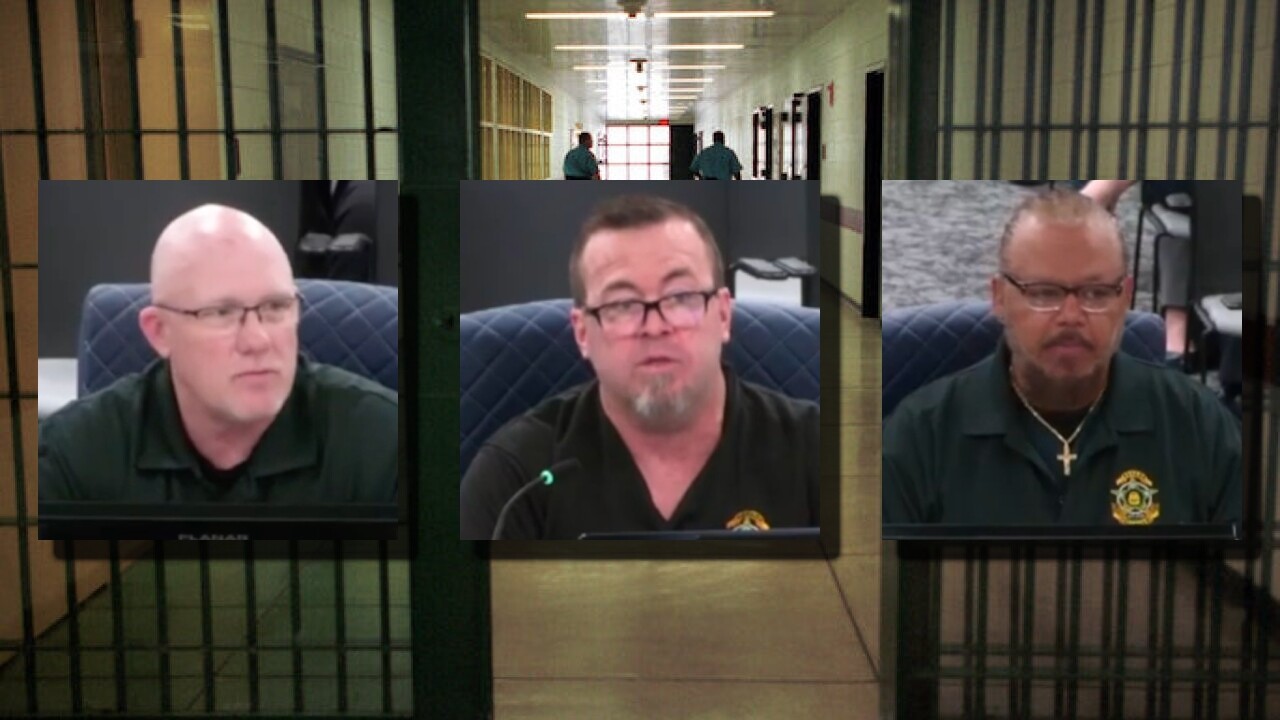

LAS VEGAS (KTNV) — The amount of overtime for prison staff continues to grow, which means more money is coming out of taxpayers' pockets.
You may remember that last April, I told you the Nevada Department of Corrections was facing a $53 million budget shortfall and the main reason was overtime. When looking at information presented to the Interim Finance Committee, from July to September 2025, more than $18 million was paid out in overtime.
APRIL 2025: NDOC officials discuss budget shortfall
There are several reasons for the overtime issues but the biggest one is needing officers to do hospital transports and hospital guarding.
"At present, only two correctional officers per shift are legislatively assigned to hospital duty, and I'm talking about just High Desert itself, not the rest of the other facilities. Yet, we have experienced situations where 10 to 15 offenders are admitted across multiple hospitals at the same time. That can require anywhere from 12 to 20 officers, depending on hospital locations and security requirements," said Robert Ashcraft, co-creator of Fraternal Police Lodge 21 and a sergeant at High Desert State Prison. "When that occurs, overtime is unavoidable. This is due to having an obligational duty to protect the public by preventing offenders from escaping. There is no practical way to forecast these medical emergencies with precision."
He added that more staffing going to hospitals leads to lower staffing inside the prison itself, which makes it a more dangerous place.
"When offenders perceive that staffing is inadequate, violence escalates. That escalation leads to more injuries, more hospital transport, and longer hospital stays, further increasing overtime costs in a cycle that becomes difficult to break," Ashcraft said. "If we cannot ensure our own safety, we cannot effectively ensure the safety of those in our custody."
It's a sentiment echoed by Jason Stinehour, who is also part of the union and works at High Desert State Prison.
"The administration is forced to drop minimum staffing. Instead of having four officers on the floor watching high-risk inmates, now we have two, which we can't do our job properly, searching cells for contraband, shanks, prison-made weapons, drugs, even though the drugs are hard to detect because they paint it on paper and they smoke the paper," Stinehour said. "When you have less officers on the floor, it's a danger to walk into an inmate's cell because they can surround you and then, there's no way because help is too far away."
In 2025, the Nevada Department of Corrections reported 76 inmate deaths, which is the highest number in at least five years. So far in 2026, 11 inmates have died, five in the last nine days alone. At least one of those was a homicide at High Desert State Prison.
"The challenges we face today are not the same as they were even a few years ago. We are managing a more dangerous offender population, increasingly sophisticated gang activity, and the introduction of new drugs that are easier than ever to smuggle into our facilities," Ashcraft said. "The decision to convert High Desert State Prison into a maximum security facility occurred before staffing and training levels were where they needed to be. At the same time, the fraternal police successfully negotiated a new contract that immediately impacted staffing numbers. While that agreement helped recruiting and retention, it did not allow sufficient time to fully train new officers for the high-risk offender population they were assigned to supervise."
WATCH | Rising deaths in Nevada prisons leave families searching for answers
There has also been a spike in drug-related issues in prisons. It's something Stinehour said he has seen first-hand.
"Another thing I do is work in the infirmary at High Desert and I see it every day, inmates coming up and overdosing," he said. "Going to the hospital, an ambulance, Flight For Life costs money. So there goes our money right there that could go to overtime to keep us safe."
Stinehour questioned if state officials really care about what's going on inside the prisons.
"They cut overtime or stop overtime from the word of the governor's office," Stinehour said. "Back in 2018, they had an interview with Sheriff Lombardo about his overtime in CCDC and he said something to the effect of I need to hire overtime to maintain minimum staffing in my jail to keep inmates, staff, and officers safe. Does he not care about our safety now since he's governor or he just cared about the safety when he was sheriff?"
Paul Lunkwitz, president of the local union and vice president of the state union, said there's enough blame to go around.
"Everyone in this room, including myself, need to take a look in the mirror. How have we failed in addressing this problem? There's a piece of this problem owned by each of you, the director, and the union," He said. "All assembly members voted to gut the funding for AB596 toward the end of the last session. Not just the majority. 42 to 0. Not only did you vote to remove the 16% increase, you voted to remove funding for provisions agreed to in the previous CBA."
AUGUST 2025: Five inmate deaths in less than a month raise questions about Nevada prison safety
Without higher salaries, union leaders state that it's getting harder and harder to recruit for NDOC positions, which are already facing a shortfall.
"The Legislature has not funded a proper relief factor, and this was clearly outlined in the $170,000 staffing study that was completed. That outside company says NDOC needs 750 more staff, including 600 more officers, and they also said all facilities should be on 12-hour shifts," Lunkwitz said. "HES and PEB are putting us in an impossible position to compete with local law enforcement agencies. 30% is what our brave men and women pay to PERS, where most local agency officers are paying less than 10% if they have to pay anything at all ... Las Vegas area prisons are already losing fully-trained officers to the City of Las Vegas and other law enforcement agencies."
When it comes to finding solutions that could help with these issues, correctional officer Larry Nava said a few programs have been discussed, including a canine program.
"In the prison system, we use the canines not only for drug detection but also to find cell phones which inmates are using to conduct business," Nava explained. "The proposed program will be entirely funded by generous donations from local casinos and businesses, and a 501(c)(3) nonprofit would oversee the expenditure of all funds. This program would cost taxpayers absolutely nothing."
Another idea the union is discussing is scanning physical copies of mail, which could potentially stop drugs from getting into the prisons.
"AB121 created an issue by making it mandatory that we give incarcerated people physical mail. There's a couple of ideas on the board right now. We've talked to Oregon, Ohio, and Michigan. What they do is they scan the mail and they either scan it to [the inmates'] tablets or they scan it and give them a photocopy of it," said Dshamba Prater, union secretary and a retired NDOC employee who worked for the department for 20 years. "This avoids the idea of the offenders getting the mail that's laced. The ink is laced. The envelope is laced. There's a number of ways that they're getting it in. This will help stop that. With the dogs being there also, this would be. like a double whammy to stop drugs from entering prisons."
As for next steps, all of the union leaders agreed they hope they can reach a resolution with lawmakers to come up with more funding to cut down on the violence and risks for all involved.
"Working behind the walls and razor wire of a correctional institution, aka prison, is unlike any other law enforcement job. We leave our families, our loved ones, and in a world where I cannot even begin to explain the perils, risks and overall danger that we face on a daily basis," Nava said. "Violence is the biggest issue in correctional facilities, which is spawned by drug use and drug debt. Whether it's staff assault, inmate-on-inmate assaults, or deaths, the issue is out of control."
"The problem is going to take the combined efforts of the legislature, the union, the governor, and the director to solve. This will require open and transparent dialogue, probably some hurt feelings too," Lunkwitz said. "You can pay for it now or you can pay for it later. I truly hope we can correct these issues before tragedy strikes our brave men and women in corrections."