



LAS VEGAS (KTNV) — Federal OSHA officials agreed that Nevada OSHA officials made the right decision when they withdrew over $400,000 in fines against The Boring Company.
Those fines were levied on May 28 after concerns about safety for both workers and first responders. You may remember that two firefighters were injured during a training exercise in the Vegas Loop tunnels.
The same day, The Boring Company reached out to the Department of Business and Industry (B&I) with concerns.
According to a previous statement from the Department of Business and Industry, B&I director Dr. Kristopher Sanchez met with Division of Industrial Relations administrators, Nevada OSHA, and legal counsel on May 29 to discuss the citations.
"During that meeting, Division legal counsel reviewed the citations (the first time a legal review of the citations had been conducted in contravention of agency best practices) and determined that the citations were in fact legally insufficient, finding that three of the four legal requirements — standard applies, standard violated, employee exposure, and employer knowledge — were not met," an email from the governor's office states in part. "At that time, the decision was made by Nevada OSHA to withdraw the citations pending further review."
WATCH: 'Hundreds of violations': Lawmakers grill regulators over Vegas Loop project
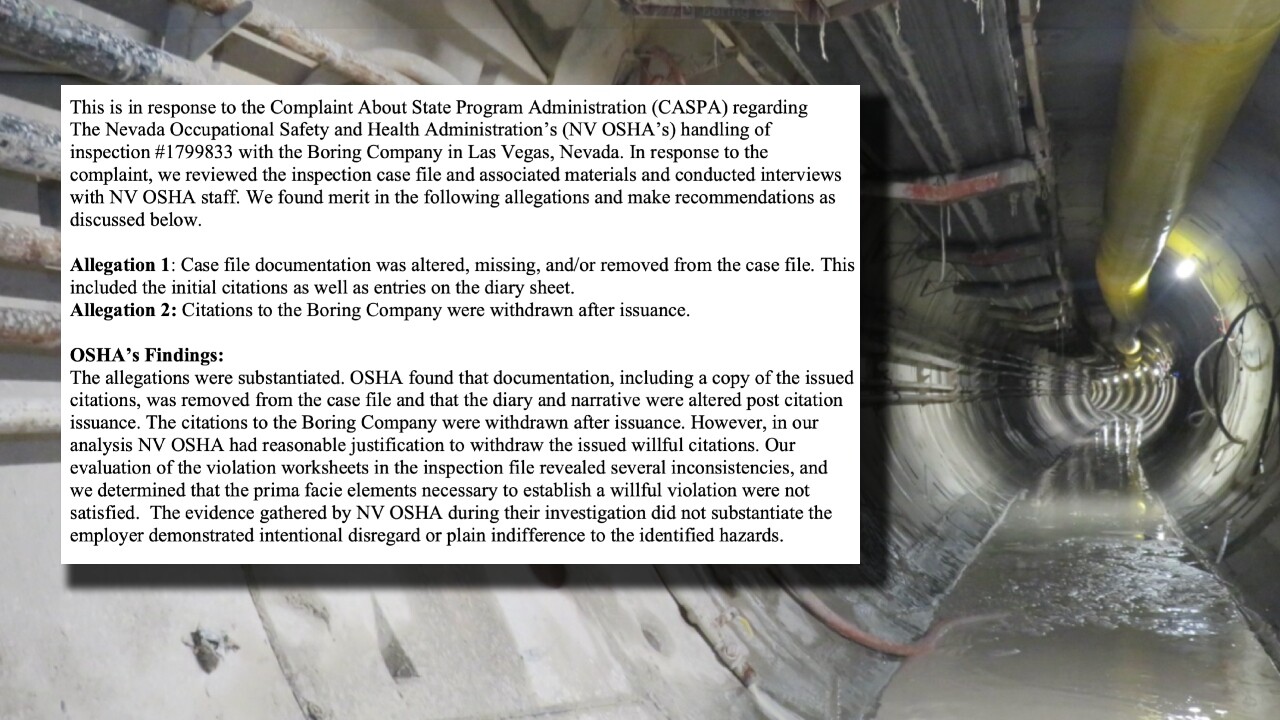
On Thursday, a letter from the U.S. Department of Labor and federal OSHA officials shows they agreed with that decision.
"In our analysis, NV OSHA had reasonable justification to withdraw the issued willful citations," the letter reads in part. "Our evaluation of the violation worksheets in the inspection file revealed several inconsistencies, and we determined that the prima facie elements necessary to establish a willful violation were not satisfied. The evidence gathered by NV OSHA during their investigation did not substantiate the employer demonstrated intentional disregard or plain indifference to the identified hazards."
That being said, federal OSHA officials found additional issues during their review:
- Engagement of Division Counsel: The Las Vegas District Office (LVDO) did not involve Division Counsel in the formulation of the willful violations. Contrary to the guidance provided in the Nevada Operations Manual (NOM) Chapter 4, as well as established past practices and training, Division Counsel was not consulted prior to the issuance of the willful violations on May 28, 2025.
- Documentation of Justification for Withdrawal: NV OSHA did not provide a justification in the case file to explain their withdrawal of the citations. NOM Chapter 5 Section 11.d provides guidance on the necessary steps to take when a citation is withdrawn during the informal conference process but does not specify necessary documentation for a withdrawal outside of the informal conference process, which may have been a contributing factor to the lack of a written justification or documentation.
- Alteration of Case File Documentation: After the decision to withdraw the willful citations, NV OSHA staff modified or removed relevant documentation from the case file. Documents from the original case file, including the signed citation package, were intentionally removed to align with the withdrawal of the willful citations. NV OSHA staff subsequently modified the narrative to reflect the updated status. We also noted minor discrepancies between diary sheet versions. The original copies of the removed and altered documents were recovered and assessed during this CASPA investigation.
WATCH: Local lawmakers probe for answers on Boring Company operations
Federal OSHA officials recommended that Nevada OSHA officials clarify in their policies when to engage with their legal counsel, require that critical events and decisions be documented, and clarify how and when it is appropriate to modify case files when a citation is withdrawn.
They also mentioned that Nevada OSHA officials self-identified several areas for improvement and have submitted at least six plan changes, which are being reviewed by federal OSHA officials to make sure they are at least as effective as any associated federal policies.



