

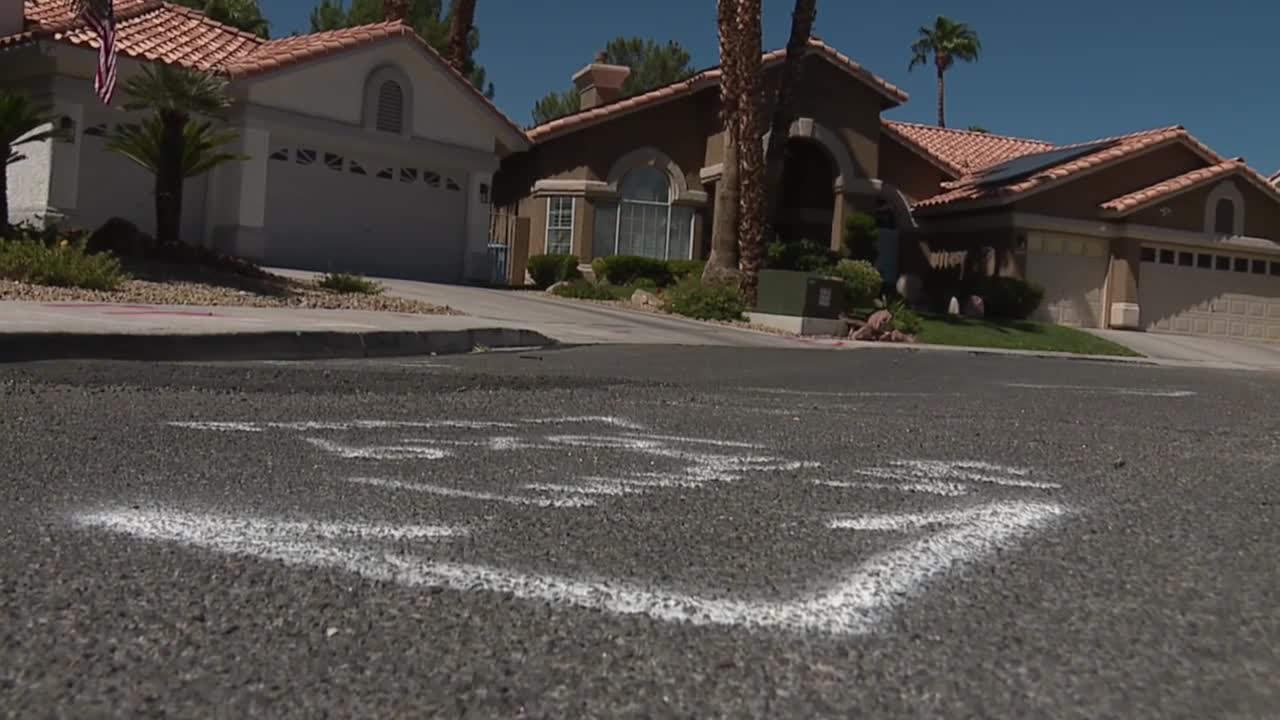


LAS VEGAS (KTNV) — Streets and sidewalks in Las Vegas neighborhoods are covered in spray paint markings left behind by utility companies preparing for a Google Fiber installation — and residents say no one will take responsibility for cleaning it up.
WATCH: Google Fiber expansion leaves Las Vegas neighborhoods covered in spray paint
Tom McCormick lives in the Heritage Estates neighborhood in Peccole Ranch, where splashes of orange, red, blue, yellow, green and white paint appear, in some cases every few feet along the ground.
"The sidewalks have been, in my opinion, desecrated. It looks like a crime scene," McCormick said, adding that the only thing missing is the chalk outline of a body. "It's just disgraceful the way it looks."
The markings are part of Nevada's 811 "Call Before You Dig" program, which requires utilities to mark their underground lines before any construction begins. Each color identifies something different below the surface — electric, gas, water, cable and sewer lines. The white markings indicate where Google Fiber, known as GFiber, plans to dig as part of a massive five-year project to bring fiber optic internet service to Las Vegas.
Will Novak, GFiber's government and community affairs manager, described the project's scope.
"It's sort of a once-in-a-generation infrastructure project," Novak said.
Novak explained why the markings are necessary.
"To ensure that we don't hit them," Novak said. "Obviously you don't want a water main broken, you don't want your electricity clipped and you certainly don't want a gas line struck."
"Utility markings are utility markings. There's a reason they do it. I get it. But did anybody think about the aftermath? No," McCormick said.
A state-level source said people have been complaining about the markings for years. The problem is that no one appears to own the cleanup. Some cities require paint removal as part of the permitting process — Las Vegas does not. Nevada state law is also silent on who is responsible for removing the paint.
When McCormick first contacted GFiber, he said the company told him the city was responsible. He then contacted the city's Ward 2 office, but went weeks without a response before reaching out to 13 Investigates.
"I said, OK, I'm going to go to 13. And here you are. Because I just want an answer," McCormick said.
Turns out, there is no simple answer or clear solution.
The city owns the streets and sidewalks in the neighborhood — not the homeowners association. But the city said it has no policy requiring utility markings to be cleaned up after projects are completed. Street sweepers are great for leaves and dust, but not effective at removing the paint.
Ward 2 Councilwoman Kara Kelley eventually responded to McCormick, acknowledging the city receives frequent complaints about the markings. Her office said there is currently no environmentally acceptable way to remove the paint. Pressure washing has been tried before, but that can leave stains as well. The current official strategy is to wait for the markings to fade over time.
Novak acknowledged the issue but said responsibility for cleanup falls on the utilities, not GFiber.
"It is a growing pain. It isn't the prettiest thing. We get that," Novak said.
Novak said GFiber's white paint is chalk-based and water-soluble, and that the utilities should also be using water-soluble paints.
"That should come off in the next couple of rains. Of course, it doesn't rain here very much. Yes, I know it doesn't," Novak said. "So that is a bit of a challenge in the desert Southwest."
He said the utilities should police themselves.
"So, is it GFiber's position then, that even though the markings are done for free, and they're done for you, for your project, it is the utility's responsibility to make sure that their markings go away as opposed to you as the contractor wanting to ensure that you restore these neighborhoods to their original condition?" I asked.
"Yeah," Novak answered, "because we are not actually allowed to touch their markings. Because we've called into 811, but theoretically, someone could've called in with another project a few days after us."
McCormick said he is concerned the markings are hurting property values and has no plans to stop pushing for a solution.
"I'm not going away. I'm not," McCormick said. "I've invested too many years in this community to just accept this. I can't do it."
13 Investigates contacted every utility involved in the project. Only NV Energy and Southwest Gas responded. Both said they are now in talks with GFiber about possible restoration efforts and other ways to address resident concerns.
McCormick has a warning for other Las Vegas neighborhoods where GFiber is headed next.
"When you see the sign in your neighborhood saying Google Fiber is coming to your neighborhood, hang on, because you're going to go through exactly what we went through," McCormick said.
GFiber said it is now exploring whether less permanent marking methods could be used as the project moves forward.
"We don't want to mess up people's neighborhood," Novak said. "My son's a Boy Scout. I know we need to leave things better than we found them, and that's what we're trying to do."
