


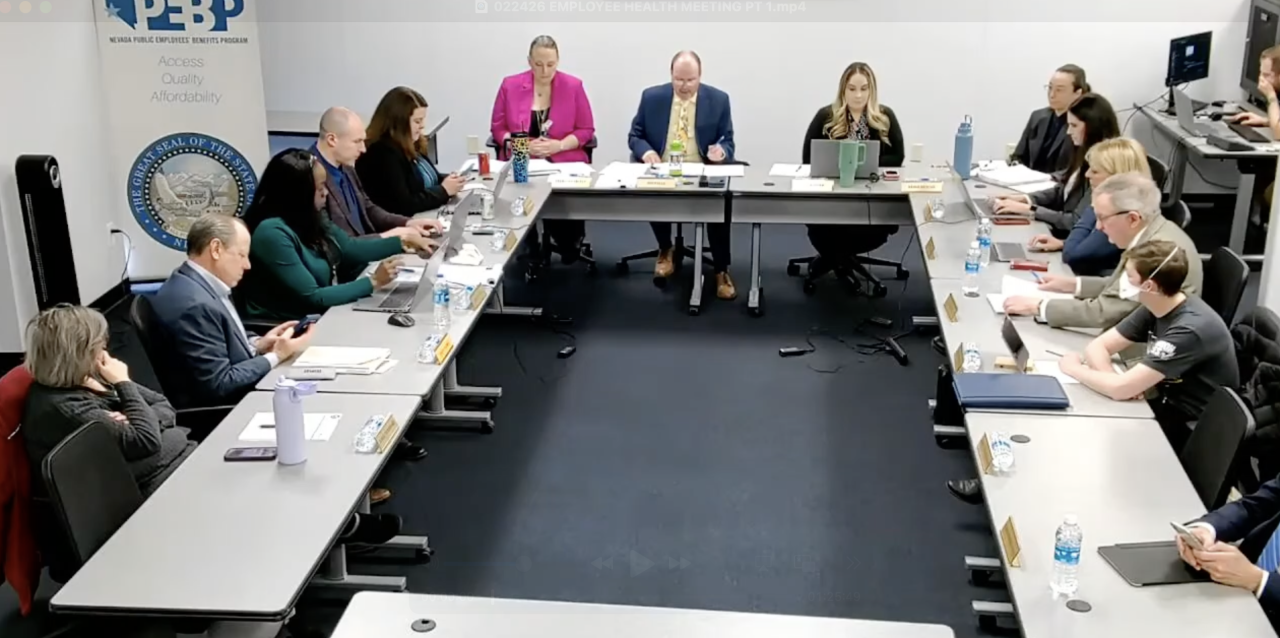
LAS VEGAS (KTNV) — Employees are asking for answers after confusion regarding the state worker health insurance program, which covers about 70,000 workers across Nevada.
The Public Employees' Benefits Program board was originally set to meet last week but that meeting was postponed due to winter weather. The meeting was rescheduled for Tuesday.
WATCH FULL MEETING
Ahead of the meeting, we heard from several state employees who were concerned about next steps after seeing an online presentation that said overall costs could go up by as much as 133%, in some cases. One of the main numbers that viewers flagged as concerning is the plans that could raise premiums by 84%.
"This new hike is something that will cause a huge burden on all government workers and appears to many of us that [the] Board needs to make a profit," viewer Jesse Mosley wrote in his email to Channel 13. "The purpose of PEBP is not supposed to be profit-making but to manage the retirement benefits for active and retired employees. This issue and lack of clarity shows a possible investigation should occur as to how the funds are being managed."
State employees submitted more than 300 pages of public comments ahead of the meeting, while dozens more spoke during the public comment period, asking the board not to drastically raise costs.
READ PUBLIC COMMENTS
"This coupled with the recent increase to our retirement deduction, or PERS, would mean take-home pay of our essential public safety officers would be greatly impacted," said Dan Gordon, the president of the Nevada Police Union, which represents almost 1,000 people who work as police officers, fire marshals, game wardens, park rangers, and agricultural officers. "Some of our members have reached out to NPU expressing their possible intention of leaving state service for other law enforcement agencies and others are expressing thoughts of leaving public safety all together. At a time when our staffing level and manpower issues are excessively low, this would be damaging for the state and public safety."
Some said it could have a similar ripple effect in other industries and areas across the state.
"This represents a significant pay cut," said Leila Pazargadi, an English professor at Nevada State University. "My concern is that when healthcare premiums rise dramatically faster than wages, total compensation falls, and that affects recruitment, mid-career retention, and our ability to compete with peer states like Arizona, Colorado, and Utah. Higher education salaries in Nevada are already modest compared to the peer states, and many of us accept lower wages in exchange for stability and benefits."
According to board agenda documents, the original goal for the meeting was to discuss and evaluate proposed changes to insurance plans, but there were questions about how much money the program actually has. That created a roadblock for discussing any changes.
However, Board Chair Jim Wells did say they weren't on board with such a significant increase.
"I will say there was no board support for the 84% increase. The 84% increase provided at the last meeting was what the actuaries determined and believed, at the time, was the amount that would be necessary to fix a problem all in one fiscal year," Wells said. "Since that time, I've had some meetings with staff regarding the way that the rates are tested. We have determined that the rates for the employer shares were not tested for plan years 25 and 26, and incorrect amounts have been transferred from AEGIS and REGI for the past 18 months. The staff is currently worked on a reconciliation of the amount that is due from AEGIS and REGI that will be transferred into the operating budget account and we're hoping to have that in the next month."
Segal is a third-party group that the board asked to look at data from previous years to figure out health plan proposals. Segal claims they did not receive correct information or there was a miscommunication, which affected the proposal they had prepared ahead of Tuesday's meeting.
"Our analysis relies upon information that's provided to us. And so, what's come to light in the last couple of weeks is that we were not provided the final AEGIS and REGI levels," said Richard Ward, a senior vice president at Segal. "And so, our projections through last month, through January, have been using rates that are higher than were in the final approved budget for the state."
PEBP executive officer Theresa Carsten stated that an internal review of the previous budget could also affect rates.
"As the review is not completed, I cannot speak to actual figures. But to date, review findings indicate that PEB has potential assets that were not previously accounted for. Once the review is completed, I will have enough information to disclose publicly the amount available. I expect this information to be available for the March board meeting," Carsten said.
That means reserve money set aside will be less than projected, which is an issue since the program has previously reported being down by millions of dollars.

Some members of the public questioned whether or not the state could use the Budget Stabilization Account, or the rainy day fund, to try to meet some of those shortfalls.
"We have funneled over $1.2 billion into a rainy day fund. Well, I think for every state employee, we should be issued an umbrella because it's raining," said Frank Fong, who is a former parole and probation officer. "I believe this is due to all the mismanagement and the incompetency and the fiscal irresponsibility that's occurred. And now, you're asking for these employees who have been loyal to the state to pay that portion back out of their fair share."
What happens next?
State officials are working to figure out exact funding numbers and levels before they make any plan changes.
Regardless of what the changes are, it will be difficult for all involved.
"We understand that any increase in premiums is difficult for our members, and we hear the concerns voiced by employees and retirees regarding affordability," Carsten said in an emailed statement. "Some adjustments are necessary, however, to secure the financial health of the program. We have worked with the board to structure options for these decisions in March in a way that minimizes impact on PEBP members, while keeping the plan solvent for everyone."
The board is scheduled to meet next month. No dates have been announced or additional materials posted on their website, as of Wednesday night. Detailed information regarding new plan options and premiums will be provided to all eligible employees and retirees after the March meeting.
If you would like to provide public comment for the upcoming changes for the March meeting, you can submit them at this link.
Open enrollment for the new plan year is scheduled to begin on May 1.