


LAS VEGAS (KTNV) — The Federal Trade Commission and consumer protection bureaus in Nevada and Utah are suing Lens.com due to alleged deceptive trade practices.
On Friday, the lawsuit was filed in federal court.
According to the lawsuit, Lens.com advertises that there are "NO HIDDEN FEES" — but attorneys allege the company imposes a "substantial, mandatory 'Taxes & fees' charge that is hidden and routinely doubles the initially advertised price."
"Thousands of Defendants' customers have complained that the actual prices Defendants charged them were substantially higher than the prices Defendants advertised and the prices they expected to pay," the lawsuit reads in part. "For example, one customer complained, 'I ordered two boxes of lenses at $67.24/each but was charged $199.91. how is this possible?'"
When a customer is going through the checkout process, this is what they see.
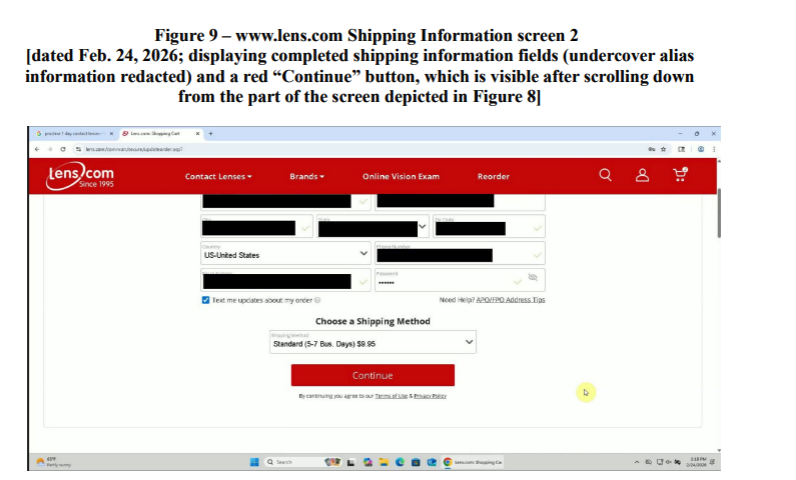
However, attorneys representing the FTC, Nevada, and Utah state that additional charges are hidden further down the checkout page.
When you look at the actual order summary, which is not visible unless the customer scrolls past the initial "Continue" button, the "'Taxes & fees'" charges substantially increase the total price Defendants charge consumers," the lawsuit states. "For example, in February 2026, despite Defendants initially advertising a total price of $18.29/box, or $146.32 for a one-year supply, the hidden 'Taxes & fees' charge imposed an additional $273.44 to the total cost."
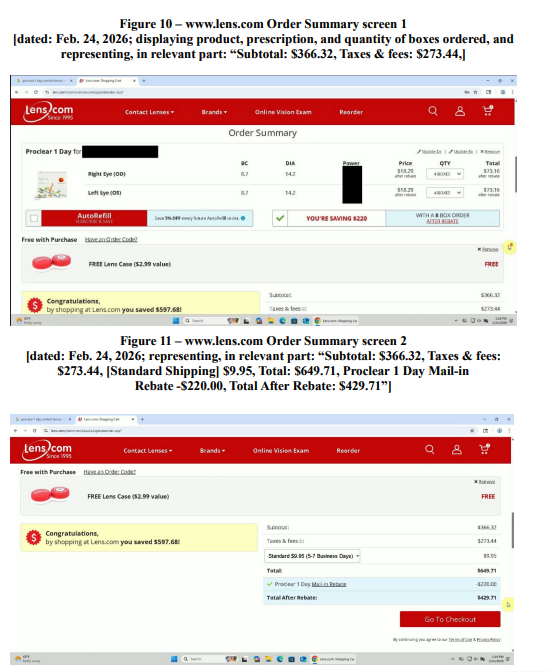
When customers continue to the shipping page, the lawsuit alleges there is an Order Summary that appears but Lens.com "hides the fact that Defendants have added a 'Taxes & fees' charge to the transaction."
In the example provided by attorneys, that means lenses that were advertised to cost $146.32 plus $9.95 shipping actually cost $649.71.
According to the lawsuit, Lens.com also charges consumers a "Taxes & fees" amount even when the consumer's state does not charge sales tax on contact lenses.
The consumer bureaus have also received complaints regarding how the Lens.com taxes are tabulated. When digging further, the lawsuit states the "'Taxes & fees,'" charge is not, even in part, for sales taxes.
That taxes and fees charge is also added to the Lens.com AutoRefill plan, which is advertised as "Subscribe & Save" and "Save 5% OFF every future AutoRefill order."

"Despite representing that consumers are 'in Control' and can 'cancel at anytime,' neither Defendants' Lens.com home page nor Defendants' purchase flow clearly and conspicuously discloses how a consumer can cancel their AutoRefill subscription, how consumers can cancel or change future orders pursuant to those AutoRefill subscriptions, or any deadlines by which to do so," the lawsuit reads in part.
Attorneys allege that Lens.com has received thousands of consumer complaints and that in response the company's service representatives "routinely admitted to the hidden nature of the 'Taxes & fees' charges."
In addition to suing Lens.com, the lawsuit also named Speed Commerce and Speed Commerce president Cary Samourkachian as defendants.
Attorneys write that Samourkachian directed and approved Lens.com advertising contracts and also participated in meetings regarding pricing policies, sales, and customer service metrics.
An email from Aug. 31, 2022 sent to Samourkachian included a PowerPoint attachment that proposed to "redesign Lens.com's online purchase flow because of the high volume of consumer complaints received regarding hidden fees."
Despite that, attorneys allege no changes were made and this practice has continued for at least four years, in violation of the FTC Act that prohibits "unfair or deceptive acts or practices in or affecting commerce," along with other state laws.
At the end of the day, attorneys write that it's not fair to issue hidden charges to consumers.
"At an average annual expense of $750 for daily contact lenses, these medical devices are a critical, substantial, and recurring healthcare cost for consumers," plaintiffs write. "Many consumers lack vision insurance and therefore pay the entire cost of contact lens purchases out of their own pocket, making price transparency and the information needed to comparison shop essential to managing these recurring expenses."
When looking at the federal court docket, no hearings have been scheduled, as of Friday afternoon.