

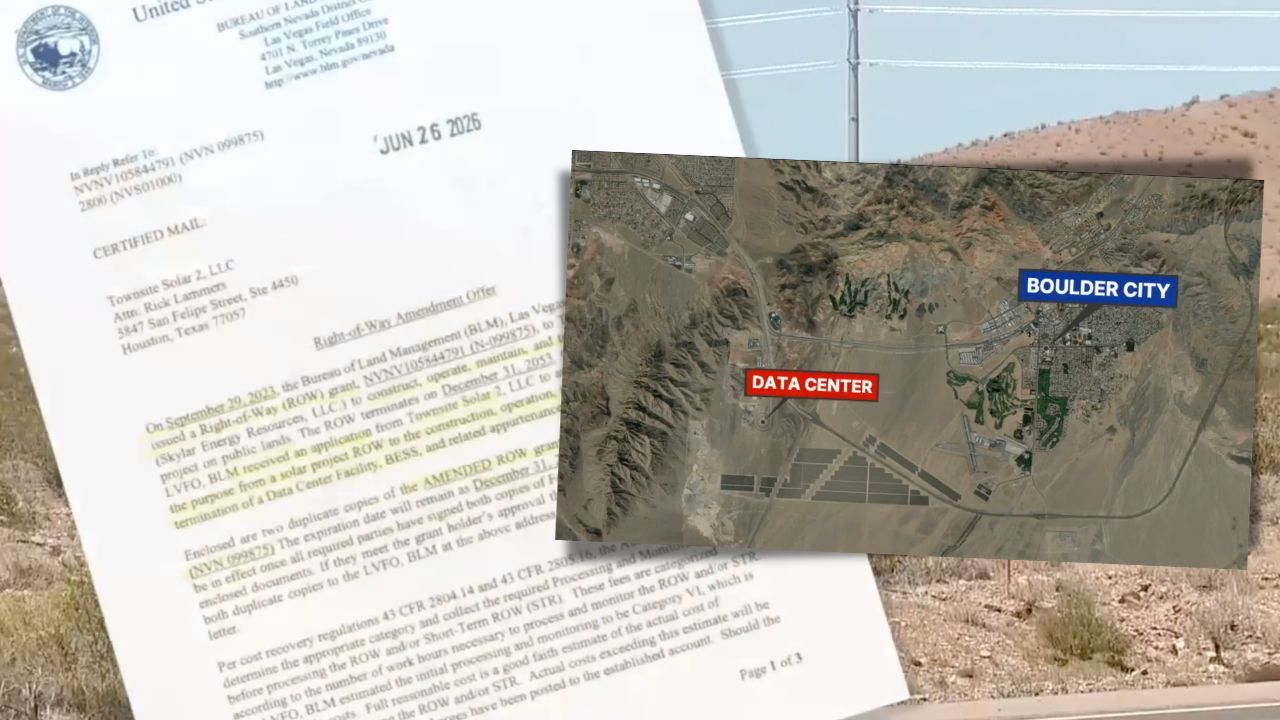


BOULDER CITY (KTNV) — Does a solar field with battery storage have the same environmental impact as a data center?
Feds say yes, but Boulder City locals are saying not so fast.
WATCH | Geneva Zoltek explains the latest on the Boulder City data center controversy:
According to Bureau of Land Management documents, two projects proposed for a plot of land outside in the Eldorado Valley are "similar in type and intensity of land use."
That's the 2026 data center proposal and a 2023 solar field proposal, which was originally intended for the same piece of land. Both were proposed by Townsite Solar 2, a Texas-based company.
But seemingly, the new project for a data center did not go through the same environmental analysis as the prior solar project.
It's the reason Boulder City officials are pushing back.
“The BLM approved something in our jurisdiction. We were not contacted by the BLM to be included in that decision," Boulder City Mayor Joe Hardy said at a Tuesday night city council meeting.
In a unanimous vote, elected officials agreed to formally appeal the BLM's decision to allow Townsite Solar 2 to construct a data center on an 80-acre parcel of federal land, but within Boulder City's jurisdiction.
"This is a departure from previous precedent and procedure as the BLM essentially sweepingly approved a new land use without following processes in federal law," Brittany Walker, attorney for Boulder City, said during a public hearing Tuesday night.
In a statement, communications manager Lisa LaPlante wrote the following:
"The federal land would receive local utilities and emergency response services, and the City contends that the BLM did not consult with the City or provide adequate opportunity for public input on the approved data center,
as required by federal law. Townsite Solar 2, LLC (TS2) previously withdrew its application to lease a nearby City-owned site."
The appeal will now go to the Interior Board of Land Appeals (IBLA), and city officials are hoping for a stay.
"If the stay is granted, it will suspend the decision until the IBLA is able to hear the appeal on the merits," Walker said.
Elected council members expressed shock and disappointment at the decision.
"I don't know in any world how they could have made the statement that that project is in any way similar to the original solar energy production and battery energy storage application that they did the NEPA for in 2023," councilman Steve Walton said. "This is absolutely out of line, just ridiculous. I don't know how they could even come to that conclusion."
According to a "Determination of NEPA Adequacy," the BLM decided a new environmental review of the data center wasn't necessary, instead transferring a 2023 assessment written for Townsite Solar 2's original plan for a 19 megawatt solar facility and battery storage site.
That three-year-old analysis has now been applied to the project's 2026 pivot to a data center. The new project would use up to 167 megawatts of power demand and include backup generators.
Channel 13 reached out to the BLM to ask about the decision, but has not heard back.
On July 22, Channel 13 received a statement from Congresswoman Dina Titus after the deadline for getting answers from the BLM passed.
“The Bureau of Land Management doubled down on its lack of transparency by failing to meet a deadline to answer my questions about a proposed data center in Boulder City. I asked the BLM to respond by July 22 to my questions about whether it agrees there should be public consultation on data centers proposed on public lands; whether the public was consulted when Townsite Solar, 2 switched its proposal from a solar farm to a data center; and whether there will be future public hearings on the new project. I suspect the BLM did not respond because it would have had to answer ‘no’ to all my questions.” — Congresswoman Dina Titus
On July 23, Titus shared in an email that she had sent a letter to Governor Joe Lombardo "asking him to halt state tax abatements for data center projects on federal land until the 2027 Nevada Legislature has had an opportunity to review the issue."
In the letter, she requested Lombardo answer four questions by August 10:
— Congresswoman Dina Titus' letter to Gov. Joe Lombardo
- "Have you or anyone in your Administration had conversations with Townsite Solar 2, LLC about their proposed project in Boulder City qualifying for the State data center tax abatement?
- Since the ROW grant has been revised to allow the construction of a data center, is it your position that Townsite Solar, LLC is still eligible for the State renewable tax abatements that your Administration previously approved?
- As Chairman of the Board of Directors of the Governor’s Office of Economic Development (GOED), will you commit to refraining from approving data center tax rebates for projects on BLM land until the State Legislature reconvenes and has an opportunity to reconsider this issue, given the community concern around the Boulder City project and the precedent this would set for other public lands?
- Do you agree that the regulatory approval process for any proposed projects to build data centers on public lands will be transparent and subject to robust public input?"
In a statement from a PR Firm representing Townsite Solar 2, we received the following information.
"Since developing the 180 MW Townsite Solar 1 project, TS2 has worked to be a responsible neighbor and long-term partner to the City of Boulder City and the people who call it home. That commitment remains central to this project. TS2 wants the project to provide meaningful, measurable benefits for Boulder City residents, local businesses, and the broader community. Our goal is to develop a responsible, sustainable project that Boulder City can be proud of and that can serve as a national model. This includes supporting water-positive outcomes by funding a City recycling effort to clean and return water to Lake Mead, powering the project with our own renewable energy sources, and creating an Energy Fund to help lower electricity costs for everyone. TS2 also wants Boulder City to receive the greatest possible revenue benefit from the project.
TS2 will follow BLM mitigation plans to reduce construction and operational impacts on the surrounding community. We propose using “direct-to-chip” waterless cooling, state-of-the-art sound barriers, heat-reducing technologies, lighting that exceeds strict Dark Sky standards, and backup emergency generation that remains well below state emissions limits. Just as important, TS2 intends to keep the community informed by sharing key operating metrics and maintaining transparency with Boulder City, its residents, and other stakeholders."
Do you have concerns about data centers in Boulder City or anywhere in the valley? We want to hear from you. Use the contact form below to reach Geneva.

