


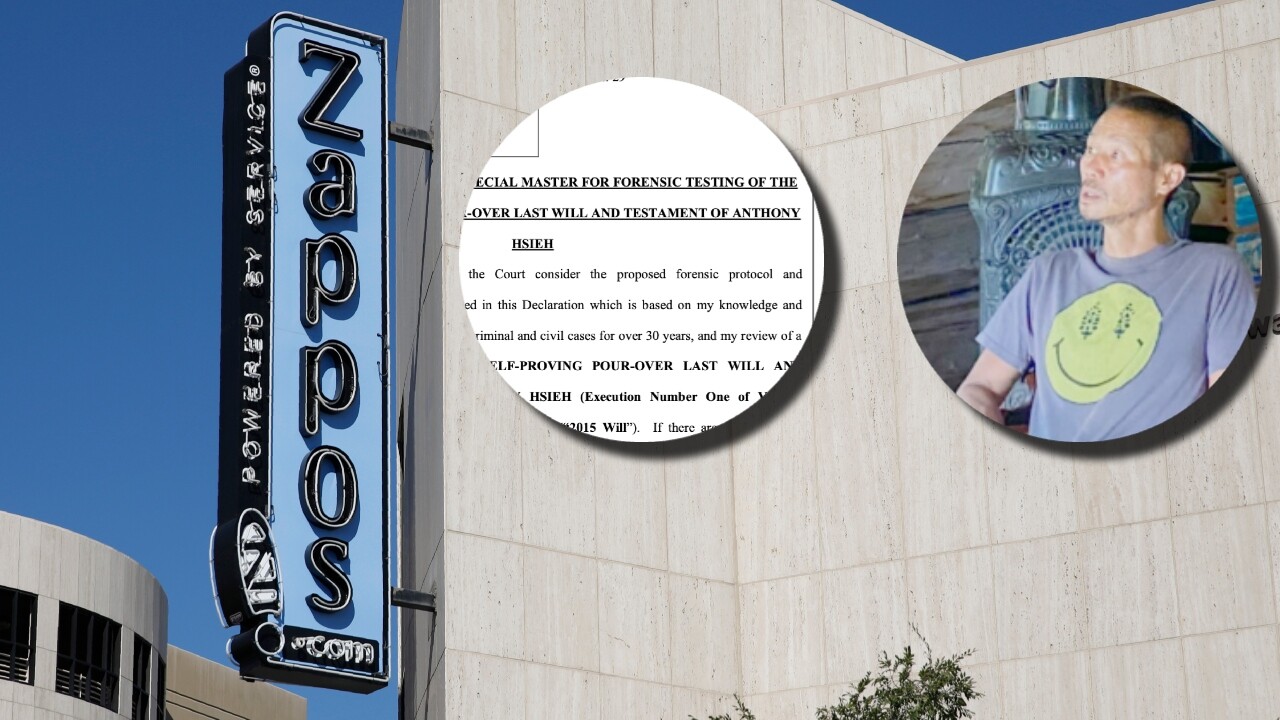

LAS VEGAS (KTNV) — An alleged will belonging to late Zappos founder Tony Hsieh could soon undergo forensic testing.
Hsieh died in a house fire in Connecticut in November 2020. He was 46 years old. Hsieh's estate is worth an estimated $513 million, and several parties have filed claims seeking a portion of that money over the past couple of years.
June 2025: Attorneys investigating newly-discovered Tony Hsieh will
In previous court filings, Hsieh's family has maintained that he died without a will, which attorneys argue is still the case.
There has been a lot of mystery and unanswered questions surrounding the alleged 2015 will. In December, I told you about several experts who told the court they believe the will is fake.
Some of the issues that have previously been brought up include:
- Tony Hsieh's signatures not matching
- Tony Hsieh's name was misspelled multiple times
- Tony Hsieh's calendar did not match up with the times and dates when the alleged will was signed
- None of Tony Hsieh's family, friends, or business associates have ever heard of any connection to anyone named in the will as a witness
- The death certificate of the man who allegedly had the will is generic and can't be fully verified to be real
- Email addresses listed in the alleged will were created after the will was signed and/or didn't exist at the time the will was signed

A Clark County District Court judge appointed a special master to look into whether or not forensic testing should be done on the alleged 2015 will. New court documents filed last week outline what kind of testing has been proposed by the special master, who has been identified as Gerald LaPorte, who is a forensic chemist and document authentication specialist.
Some of his suggestions include physical, microscopic, optical, and chemical testing.
"Documents can be fraudulently composed using multiple methods, such as forging a signature; substituting a page(s) in a multiple page document; altering clauses and/or verbiage within a page; electronically copying an authentic signature from one source and 'pasting' into the questioned; and executing a signature on a date later than purported to have been. signed, i.e., backdating," LaPorte writes in part. "Many critical features, such as ink characteristics, line quality, pressure patterns, indented or impressed writing, paper properties, and the identification of a potential tracing, are highly complex and must be evaluated using a range of forensic laboratory equipment."
LaPorte also stated DNA testing and latent print examination for fingerprints and palm prints should also be done. However, he says there could be multiple samples on the document since it's been handled by so many people since it was discovered.
You can read more of his recommendations below.
Attorneys for Hsieh's father, Richard, state all parties had a Zoom meeting with LaPorte this past Thursday to go over the proposed testing.
Hsieh's attorneys objected to several recommendations. For example, they stated fingerprint and DNA section is "premature as it may be unnecessary and should be the last thing done." They also objected to the handwriting analysis "since no party had requested it" but said they didn't want to delay forensic ink testing and the handwriting analysis could proceed.
LaPorte also stated the examination for handwriting analysis and forensic testing will be conducted on-site at the courthouse on a single day and that removing the alleged 2015 will from the courthouse "is not necessary".
Court records show the testing date has been set for June 1.
WATCH KTNV 2021 SPECIAL: Tony Hsieh: The Rise, The Fall, The Future
As for the case overall, it is making its way through both Clark County District Court and the Nevada Supreme Court. Hsieh's attorneys have questioned the two attorneys that the District Court appointed as co-special administrators as named in the alleged will and they were concerned the alleged will authorized those attorneys to "use the Estate's own resources to 'promote' and 'defend' the contested will" claiming "there is no legal precedent" for that decision.
Hsieh's attorneys filed a writ of mandamus with the Nevada Supreme Court in January, which the co-special administrators have not filed an answer to. The Supreme Court docket shows they have requested several extensions.
"The Petitioners apparently recognize the Minute Order created uncertainty but argue that Co-Special Administrators should nonetheless only receive a ten-day extension of time," writes Attorney Jennifer Willis, who is counsel for Mark Ferrario, one of the attorneys named as co-special administrator of the Hsieh estate in the alleged 2015 will. "This argument overlooks the realities of balancing competing deadlines and obligations in other cases, and the coordination that is required among separate counsel for the Co-Special Administrators who intend to file a joint response in order to avoid duplicated work as instructed by the District Court in the Minute Order."
Last Monday, Willis asked the Nevada Supreme Court if they could have until June 4 to file a response.
Meantime, when looking at the District Court docket, there is a motion to stay proceedings until the Nevada Supreme Court rules on the petition for writ of mandamus. The next District Court hearing to go over that motion is scheduled for May 28.