



LAS VEGAS (KTNV) — Officials on every level of Nevada government and law enforcement are looking for ways to tackle a major issue in our state: safer roads.
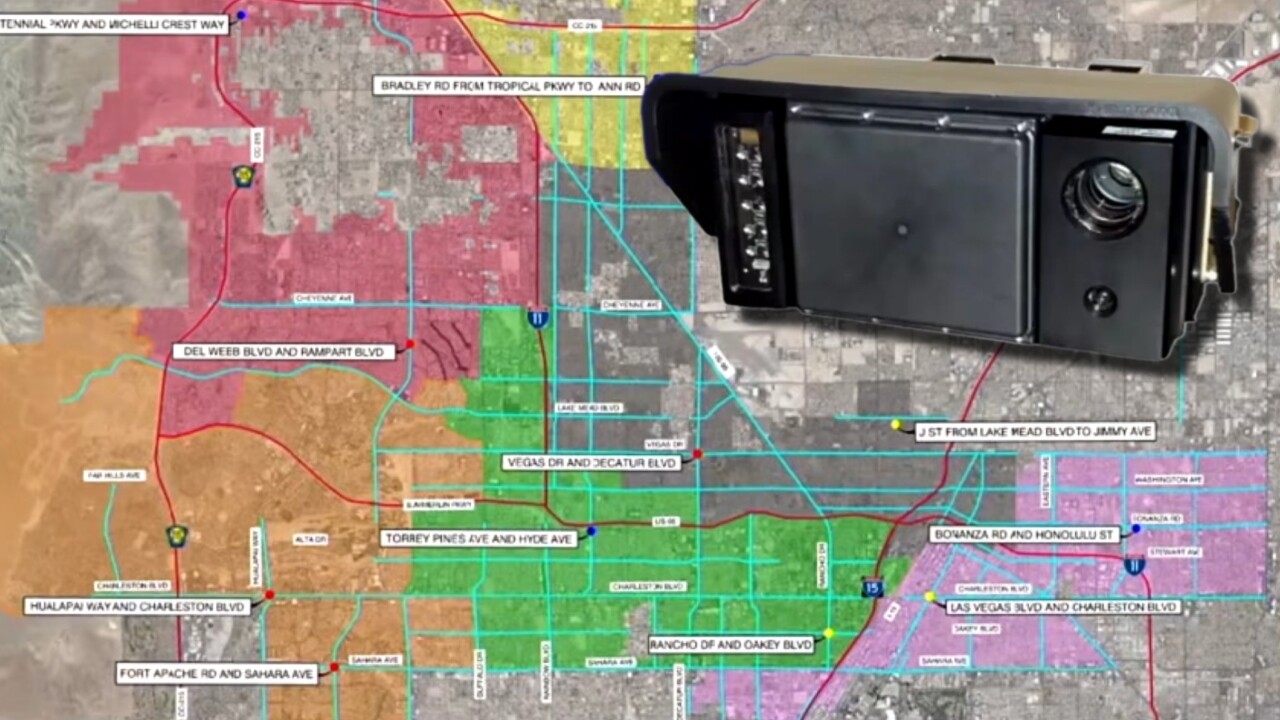
That's why the City of Las Vegas and the Las Vegas Metropolitan Police Department are looking at a pilot program to add 12 traffic cameras across the valley, through an agreement with a company called Ludian.

On Tuesday, Brian Knudsen, Ward 1 councilman for the City of Las Vegas, and Metro representatives gave a presentation on the program to the Joint Interim Standing Committee on Growth and Infrastructure.
Knudsen said city officials have tried several options to try to make roads safer, including speed humps in neighborhoods, blinking stop signs and painted crosswalks.
"I have done all of those things to no avail and it has no impact on traffic safety," Knudsen said.
He also gave an example of the city putting in monument signs in the Glen Heather Estates neighborhood in an effort to curb bad drivers.
"Someone was speeding down Rancho, took a hard right and knocked the sign over," Knudsen said. "It's going to cost us $30,000 to put that sign back up."
According to Knudsen, that frustration led him to speak with Sheriff Kevin McMahill to ask what elected officials can do to help.
"I get asked at every single community meeting I go to, every single constituent I meet with, it used to be homelessness, now traffic comes up," Knudsen said. "I'm desperately trying to figure out how to make an impact to make our community safer because that's what my community asked me to do."
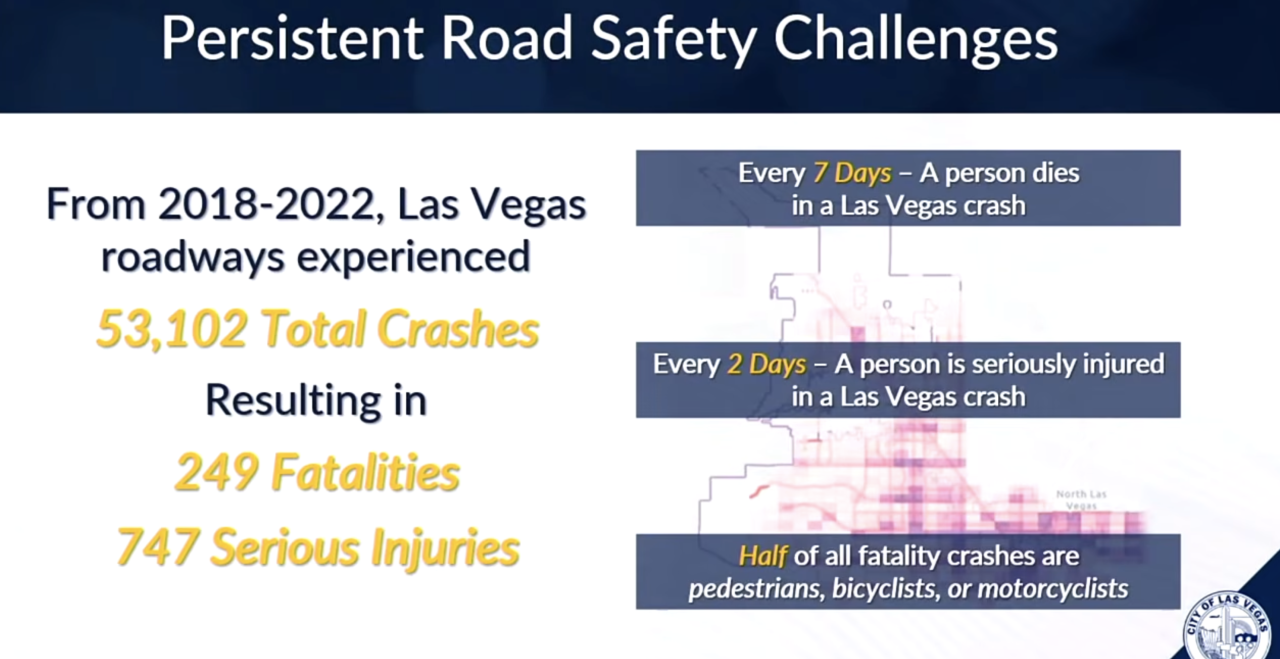
Data presented to lawmakers shows that from 2018 to 2022, Las Vegas roadways experienced over 53,000 total crashes, and that every two days, a person is seriously injured in a Las Vegas crash.
Another example Knudsen gave state lawmakers is that during a recent road safety analysis project by the RTC, in a single month, there were 6,555 red light violations at Charleston Boulevard and Valley View Drive.
Knudsen said he's been working with city leaders and Metro to develop the pilot program over the last six months.
"The idea we came up with is to put two cameras up in each ward, so a total of 12 cameras," Knudsen said. "We wanted to cover high-crash intersections. We wanted to cover school zones. We wanted to cover construction zones."
You can see the list of tentative locations below.

The list of tentative locations includes:
- Bradley Road from Ann Road to Tropical Parkway
- Centennial Parkway and Michelli Crest Way
- Torrey Pines and Hyde Avenue
- Bonanza Road and Honolulu Street
- Rancho Drive and Oakey Boulevard
- Las Vegas Boulevard and Charleston Boulevard
- J Street from Lake Mead Boulevard to Jimmy Avenue
- Hualapai Way and Charleston Boulevard
- Del Webb Boulevard and Rampart Boulevard
- Decatur Boulevard and Ann Road
- Fort Apache Road and Sahara Avenue
- Vegas Drive and Decatur Boulevard
If the Las Vegas City Council approves the measure on Wednesday, the pilot program will run for one year. The pilot program will cost just over $400,000, and the money is coming from RTC funds that are earmarked for traffic safety initiatives.
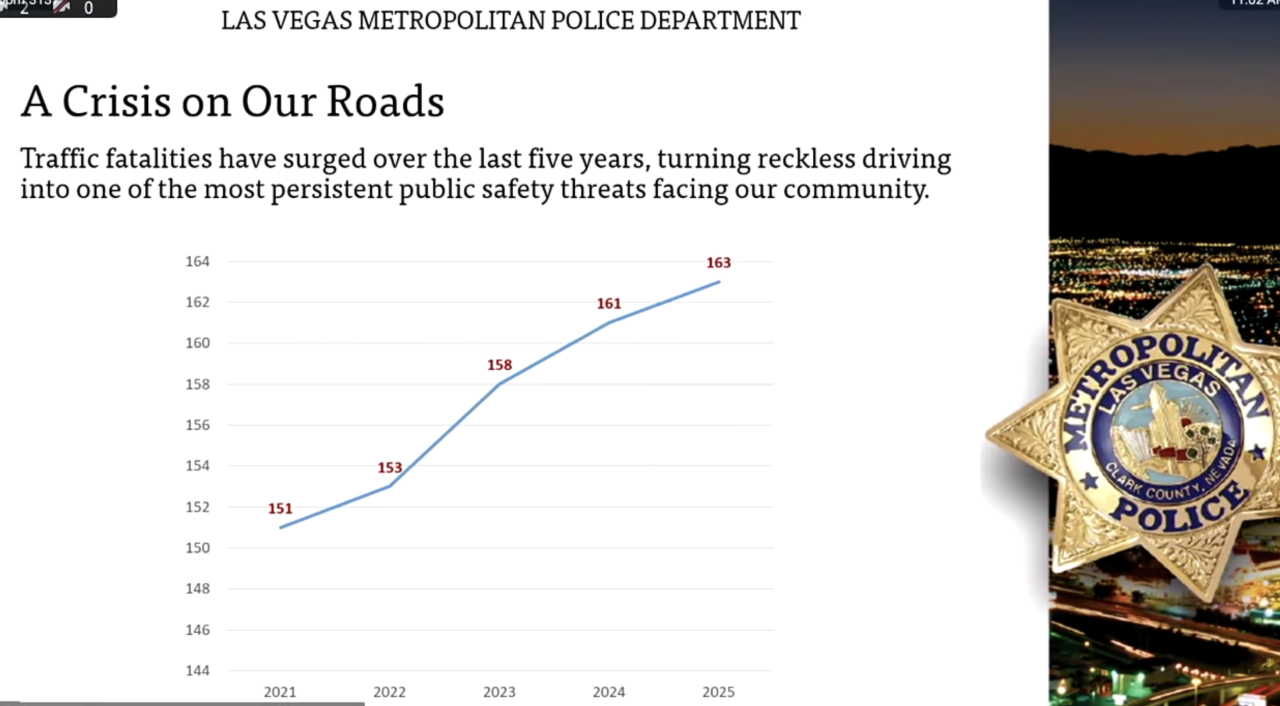
Assistant Sheriff Dori Koren said this is one way to help officers, who are also being affected by what they're seeing.
"It is really hitting home to a lot of our officers because they're the ones in the field. They're responding to these fatalities. They're seeing it. They're smelling it. It's going home with them and it's really affecting their psyche," Koren said. "Traffic fatalities are truly indiscriminate. Every single person in this room is subject, hopefully nothing happens, but is subject to the dangers that you're seeing on the roadways. Whether you're driving to and from work, whether you're walking to and from school, whether you're driving a very nice car in one area of town or you're driving a different car that's not very nice, or you're a pedestrian, it's indiscriminate. We're seeing too many people die."
Koren also emphasized that officers can't be everywhere all at once and that technology is allowing the department to be more efficient.
"For comparison, to cover 12 intersections with cameras to reduce behavior causing fatalities in comparison to put officers there is $400,000 versus $12 million to $15 million," Koren said. "If that is the only solution, we need more officers to get ahead of the traffic fatality problem, but we know it's also unlikely and unreasonable to ask for more officer funding to cover the traffic problem alone."
WATCH: Sheriff McMahill: Drones, AI changing how Las Vegas police fight crime
Koren also stated while police have made progress on reducing the number of homicides and officer-involved shootings, diverting officers to deal with traffic issues does impact their resources.
"We've had tremendous success in combating crime in the past four years, with Sheriff Kevin McMahill. We've reduced murders by 43%. It's just remarkable. There's less people getting killed in Las Vegas and Clark County, as a whole. We've reduced officer-involved shootings by 57% in the last year alone," Koren said. "But now that we've shifted to try to also address the traffic fatality crisis, we're starting to lose ground on murders. We're up a little bit right now. We're not willing to give up. We're still fighting that. We're still going to do everything we possibly can to succeed in all areas at the same time, but there are limited resources, which is why we're often looking at technologies to augment what we're doing."
One of the issues that lawmakers brought up is there could be major privacy concerns with these cameras being installed.
"During the last session, this was the number one issue that came up," said Assemblymember Max Carter. "It's going to be worse because of the Flock scandal."
In 2023, Metro entered into an agreement with Flock Security, a company that uses license plate reader cameras to collect vehicle information and cross-reference it with police databases. According to a February report by the Nevada Independent, Metro operates approximately 200 Flock license plate reader cameras on city or county infrastructure and shares that data with hundreds of state and local law enforcement agencies across the country. One of the main donors that helped fund those cameras was the Horowitz Family Foundation, which is connected to venture capitalist Ben Horowitz.
"Right now, we're dealing with a perception that's hard to refute that some billionaire decided he wants to put license plate readers around the Las Vegas valley that has no oversight by the electeds, and it's broken the public trust," Carter said. "I think that needs to be addressed first before we can even attempt to have a conversation with our constituents about this."
Doren stated there are some misperceptions about how those cameras were purchased.
"In 2017, when we bought the cameras, we [also] used department funds and Homeland Security grant funds," Koren said. "It's not purely, privately funded."
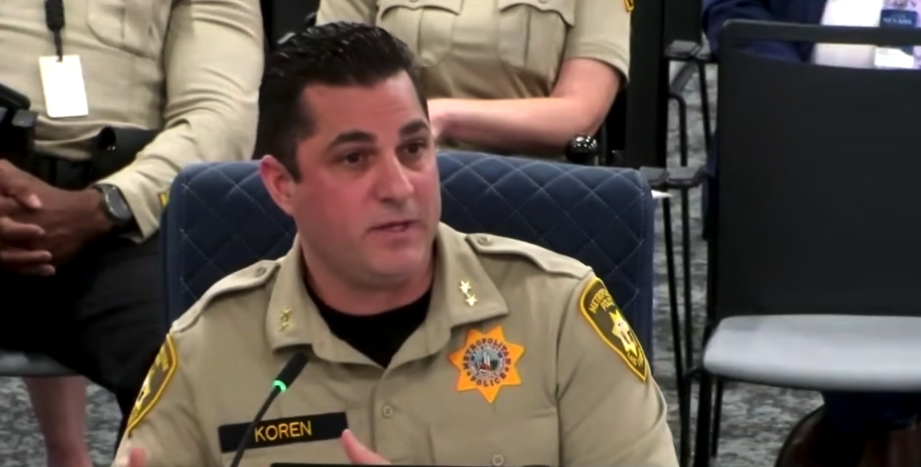
Koren added that other donors that have contributed to the department in the past include the Englestad Foundation, the Vegas Golden Knights, the Las Vegas Raiders, and an "extensive list" of hotels, companies and private individuals.
As far as public trust is concerned, Koren said Metro has had success but "we still have room to go."
"We have to try to educate the community and get feedback to overcome those issues," Koren said. "The feedback we're getting from victims and the community is overwhelming support. Beyond having a data retention period and transparency and auditing mechanisms, I think the other thing we do to address public trust is we need to better educate people on the perceptions in our community."
When looking at some of the safeguards that city officials and law enforcement plan on putting in place with the traffic camera pilot program, the cameras are uniformly distributed to "avoid disproportionate impacts," data collected will not include images of the driver, passengers, or rear windshield, facial recognition or biometric identification technology will not be allowed, and data is confidential and only accessible by program administrators.
So what information is collected?
According to the City of Las Vegas, the system will provide city traffic engineers with information that looks like the sample below. The system does not retain any video and only provides data. The cameras are also site-specific and not affiliated with the Flock network of cameras.
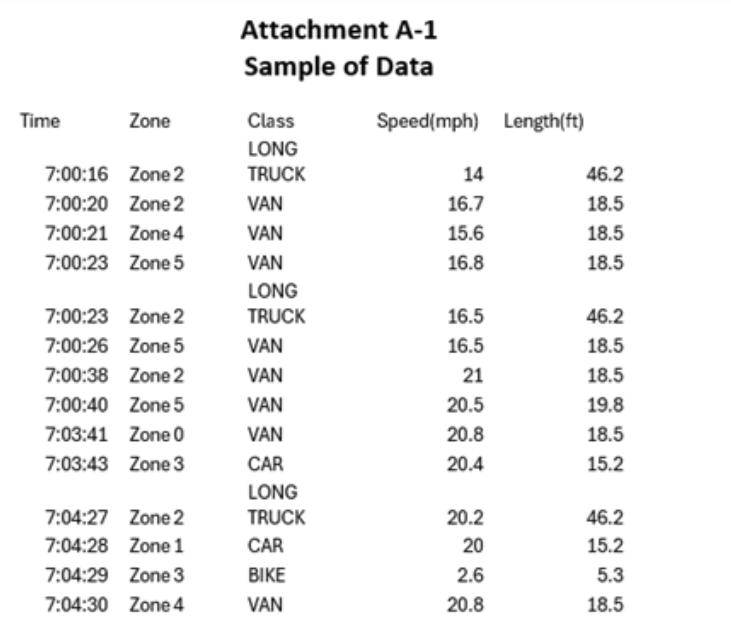
Sen. Rochelle Nguyen said she was skeptical of this being implemented due to some of the same concerns brought up with bus cameras.
WATCH: CCSD delays bus camera contract, citing complexities and concerns as next steps unclear
"The focus always came back to the money," Nguyen said. "It might not be your intention, but I think when you're using third-party vendors that are profiting off of this, that's where my concern comes into play."
Carter stated that while there are valid concerns over the cameras, he has also seen how Metro's cameras have a positive impact on his constituents in Henderson and east Las Vegas.
"We had an issue there nine or 10 years ago where Metro did things right. We had an issue with problems on construction in Lewis Family Park. Metro came in and put one of their freestanding cameras, highly visible, and the public was outraged," Carter said. "Then, the public realized I can take my kids to the park after dark now ... We went from the public coming out saying don't improve the park, lock the bathrooms up, to we want cameras in our park, highly visible ones. Now there is a constant demand for that."
As for next steps, the city council will vote on the measure on Wednesday. Knudsen said he hopes this is a step in the right direction to make Las Vegas safer.
"This is the beginning of a conversation. This is not the end of a conversation," Knudsen said. "I'm not a big fan of collecting information but I am trying to be responsive to our constituents and I don't have many other options."
If you would like to learn more about this pilot program, you can read a blog post on the City of Las Vegas website by clicking here.