


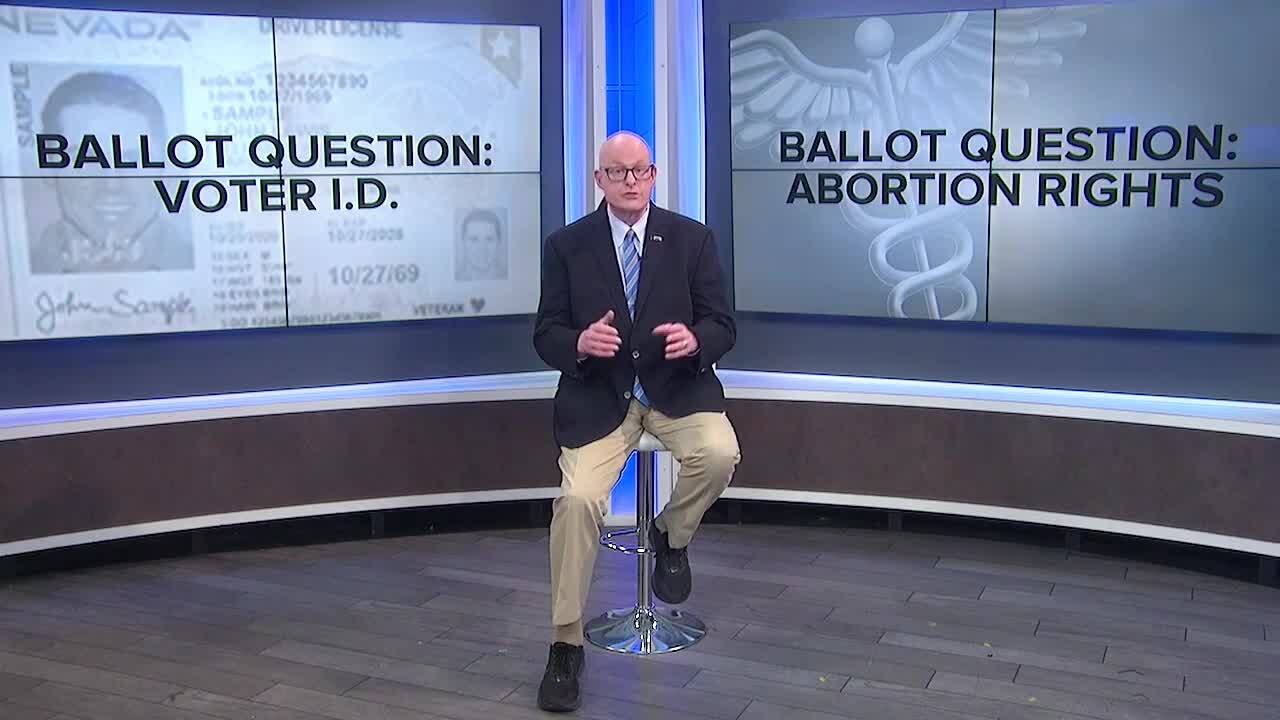

LAS VEGAS (KTNV) — Although Nevada voters have faced as many as 10 ballot questions in a single election over the past 25 years, there will only be two on this year's ballot.
Question 6, which would enshrine abortion rights in the Nevada Constitution, and Question 7, which would impose a requirement to show a photo ID when casting a ballot, await voters in November.
If those questions seem familiar, it's because they are. Under the Nevada Constitution, voter-initiated amendments require two votes of the people at successive general elections in order to take effect.
In 2024, Question 6 passed with a healthy 64% of the vote. But Question 7 passed with an overwhelming 73%. That's the single-highest "yes" vote on an initiative in at least the last quarter century.
You'd have to go back to 2016, when an initiative that sought to deregulate Nevada's electricity market passed with 72% to find a similar result. (And, two years later, that measure was rejected by 67%, still the greatest two-year swing in voter opinion in Nevada initiative history.)
And in 2014, a gross receipts tax was rejected by nearly 79% of voters, with just 21% in support. And in 2002, voters rejected a proposed tax exemption for car racing equipment with 78% of the vote.
WATCH | Senior Political Reporter Steve Sebelius sat down with one of the organizers behind one of the ballot questions to learn more:
Question 7: Voter ID
Dave Gibbs, the man behind voter ID Question 7, says he attributes the result in 2024 to the popularity of the idea, not only among Republicans, but Democrats and nonpartisan voters as well.
"In fact, just this year, in March, CBS did a poll: 80% of the people across this country are in favor of it," Gibbs said in an interview with Channel 13. "Every demographic, men, women, race, even party — 65% of Democrats are in favor of showing an ID when you go to vote."
To be sure, it would be impossible to get a 73% support number — more than 1 million actual votes, a record — without having some Democrats and nonpartisans on board. While the two major parties account for about 28% of the Nevada electorate, nonpartisans make up fully 38%, a statistic that's been on the rise for years.
Gibbs said he took on voter ID after several attempts to pass a bill at the Legislature failed, and previous initiatives were felled by legal challenges or an inability to acquire signatures. A 2022 effort led by Gibbs survived a court challenge, but organizers did not have time to collect enough valid signatures.
But Gibbs kept at it, knowing the initiative process was the only way to get the matter in front of voters.
"And basically. I got tired of hearing people complain, and nobody successfully doing anything about it," said Gibbs, who based his measure on similar laws in Texas and Georgia, but modified for the Silver State.
Gibbs personally circulated petitions, along with volunteers around the state who believed in the cause. Gov. Joe Lombardo supported the measure and donated money that helped gather enough valid signatures to qualify for the 2024 ballot.
Under Question 7, voters would have to show a photo ID when voting in person at the polls during early voting or on Election Day. People who vote by mail would be required to write an ID number — the last four digits of a Social Security number or driver's license number, for example — in addition to signing the outside of their mail ballot envelope.
Critics argue the measure is unnecessary, saying the existing system is sufficient to verify a voter's identity, and that in-person voting-in-the-name-of-another fraud is vanishingly rare. They say people without an ID — older drivers whose license has expired and who no longer drive, for example — could be disenfranchised.
But Gibbs said the list of acceptable forms of ID is generous — it includes public college student IDs, tribal IDs, government employee IDs in addition to driver's licenses and passports. And, he says, the measure gives the Legislature room to expand the list of acceptable forms of identification in the future.
For him, it's about confidence in elections.
"You know, they're elections. People need to have faith," he said. "You have all of these processes, and the way your government works, people need faith in it because they need to have faith that the process is accurate, the process is good, the people doing the process are good and the results are good. If you lose faith in that process somewhere down the line, you lose faith in the outcome, which in our case means you lose faith in the legitimacy of your elected officials."
Even if the measure passes in November — it's widely expected to win approval again — there will still be more work to do. Election officials will need new rules and training to follow those rules. Mail ballot machines will need to be reconfigured to check for ID numbers. Workers will need access to ID numbers and training on how to check those numbers against a state database.
"It ain't done until the paperwork's done," he said.
Question 6: Abortion rights
Question 6 was filed in the aftermath of the U.S. Supreme Court's 2021 ruling in Dobbs v. Jackson Women's Health Organization, which overturned the 1973 decision in Roe v. Wade that said abortion was permissible before a fetus is viable and Planned Parenthood of Southeastern Pennsylvania v. Casey in 1992, which reaffirmed the holding in Roe.
In Nevada, abortion rights are protected under a voter-ratified passage in state law, which cannot be changed except by a vote of the people. The holding in Dobbs thus didn't affect residents of the Silver State.
(Channel 13 prepared a timeline of events leading to Question 6's getting on the ballot, and spoke with one state lawmaker after the Dobbs ruling who called it "devastating.")
But if Congress were to pass a law outlawing abortion nationwide, a state constitutional provision granting abortion rights could protect residents here, unless the Supreme Court ruled abortion rights were unconstitutional, one legal expert has said.
Critics of the measure have said it too broadly defines who may perform abortions, potentially putting women in danger. But supporters say the fights around the nation over state-level laws that broke out after Dobbs require additional protections for Nevadans.
Krystal Ortiz of the pro-Question 6 group Nevadans for Reproductive Freedom said the 2024 vote showed Nevadans support the measure.
“Nevada voters spoke loud and clear in 2024, voting overwhelmingly to create strong constitutional protections for abortion rights with Question 6," she said in a statement. "However, we know that anti-abortion radicals are not giving up, and we won't take anything for granted in 2026.
"We look forward to a robust campaign to remind voters that they will again have the opportunity to vote to protect fundamental reproductive rights this year, and we look forward to passing Question 6 and permanently enshrining reproductive freedom in the Nevada Constitution.”
But the group Nevadans Right to Life on its website calls the measure "dangerous."
"If it passes in 2024 and 2026, abortion will be an individual fundamental right without limit. No doctors. No safety regulations. All nine months. No parental involvement for underage girls seeking an abortion," the site says. "Risky for women. Dangerous for girls. Deadly for the almost-born. Bad for Nevada."
If you have a question about Nevada politics, reach out to Steve by clicking on the banner below:
