

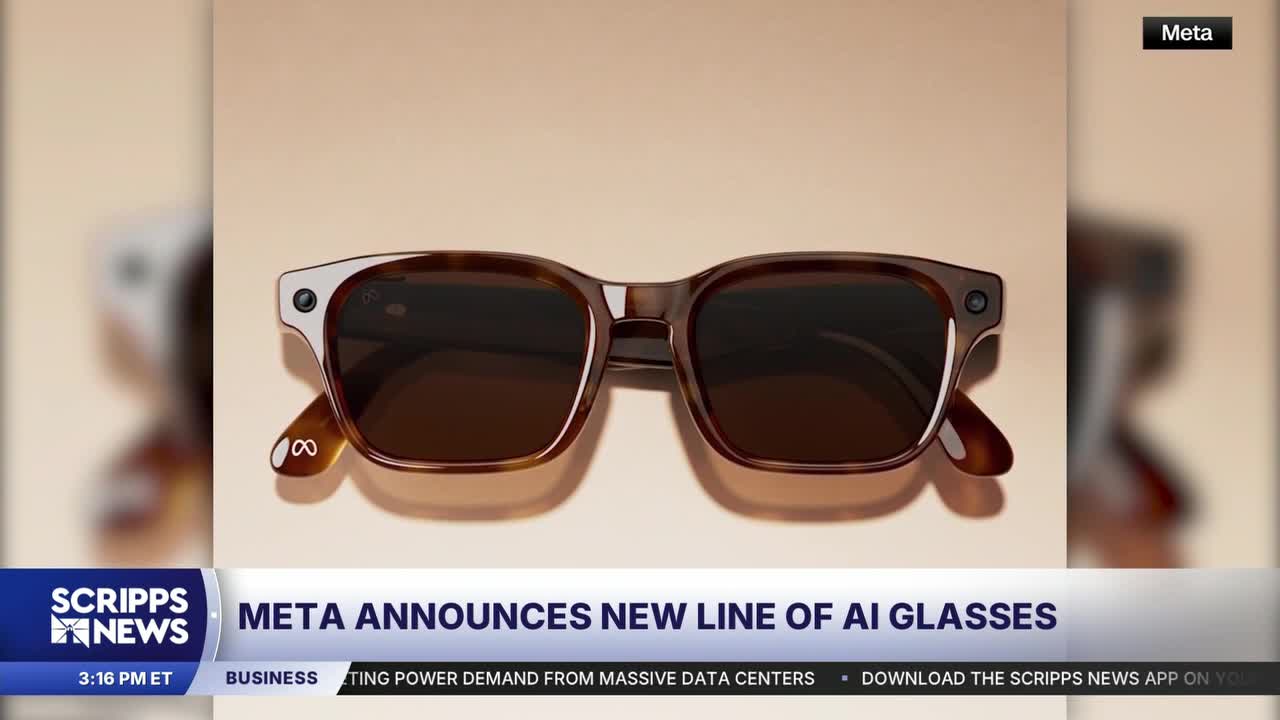


Meta on Tuesday announced a new line of AI glasses designed in-house, signaling a deeper push into the wearable technology that’s become a new front in the artificial intelligence race.
And the biggest change consumers will notice? A cheaper price tag.
The new Meta Glasses will start at $299, making them less expensive than the latest Ray-Ban models which begin at $379. And that could help get them in the hands of more people, which is critical for Meta as it faces pressure to prove its massive AI investments will generate hit products.
RELATED | Google plans to launch its first AI-powered glasses
“You really want to be able to be in many places in the market, so reaching people isn’t just about even design and style, it’s also about the price point,” Andrew Bosworth, Meta’s chief technology officer, said during a press event on Monday.
The Meta-designed glasses represent a departure from the co-branded spectacles the social media giant previously released with EssilorLuxottica’s Ray-Ban and Oakley. (Meta still partners with EssilorLuxottica on certain aspects of the new glasses, like the lenses, and continues to sell the Ray-Ban and Oakley models.)
Bosworth added that consumers are willing to pay a premium for Ray-Ban styles because of their popularity, and that the new in-house frames are meant to provide consumers with more options.
The glasses come in three styles: a small frame called Adventurer, a larger and slightly rounder one called Fury and an oval model designed by Kylie Jenner called Meta Glasses by Kylie.
The new glasses can play music, translate languages and answer questions about a person’s surroundings by capturing images with the glasses’ cameras, like Meta’s Ray-Ban and Oakley glasses. The company claims its new Muse Spark AI model improves how the glasses can extract details from photos and remember personal preferences.
Meta Glasses will launch with Muse Spark, while the company’s previous glasses will get the new model through a software update.
When CNN tried the glasses during a press event ahead of launch, they were able to estimate the number of calories in a bowl of strawberries, translate a sign from Arabic to English and provide nearby museum recommendations. The glasses could also tell the container of fake cherries used as a prop during a demo weren’t real.
Still, these scenarios are comparable to what Meta’s existing glasses can handle and likely won’t convince people who are skeptical of or uninterested in smart glasses. The Jenner-designed model is the most distinctive; they have a custom chime sound that plays when a user puts on the glasses, and the standard Meta AI voice can be replaced by an AI-generated version of Jenner’s based on her real voice.
RELATED | Meta launches new AI search mode and photo editing tools on Facebook
Tech companies are still struggling to prove to consumers that smart glasses and other new types of wearable gadgets, like pins that record and transcribe conversations, are more useful than smartphones, according to Runar Bjorhovde, an analyst covering mobile devices for market research firm Omdia. That can make it difficult for some consumers to justify the price.
“The question is whether these wearables can do something completely unique or something completely different, using the camera (and) creating context in the world,” he told CNN earlier this month. “And the question is, what do you actually do with that?”
But prices for smart glasses are expected to come down over the next four years, potentially making them more popular, according to market research firm The International Data Corporation. The average selling price of smart glasses is expected to drop from $376 in 2026 to $229 by 2030.
But price isn’t the only concern when it comes to smart glasses; the company has grappled with ongoing privacy concerns. CNN reported earlier this year that some men have filmed videos of themselves flirting with women using smart glasses and uploaded the clips to social media without the women’s consent.
All Meta’s glasses have an LED light indicating when the glasses are recording. Meta’s website also says the camera won’t function unless the LED light is clear.
“It is a cat and mouse game with people who are bad actors,” Bosworth said, at Monday’s press event. “We try to make sure that we’re doing everything we can generationally to continue to improve, making sure that light is the indicator that bystanders can rely on to understand what’s happening on the glasses.”
Smart glasses, especially Meta’s, are gaining traction: The IDC reports that shipments of smart glasses surged by 167% in the first quarter of 2026 compared to the same period in 2025. And Meta dominates the space with 69.2% of the market, the firm found.
Meta CEO Mark Zuckerberg said in an April earnings call that the number of people using its glasses daily has tripled year-over-year.
But Meta will soon face more competition. Google and Samsung are collaborating on a new pair of AI glasses launching later this year with similar functionality. OpenAI is also developing a hardware product.
ChatGPT and Google’s Gemini are already significantly more popular than Meta’s AI assistant, according to Pew Research, which reports that 44% of American adults use ChatGPT, while 24% use Gemini and 14% use Meta AI.
“Google enters the smart glasses race with an advantage no rival can manufacture overnight: an ecosystem already embedded in billions of lives,” IDC analysts wrote in a June 15 report. “Gemini is already in people’s email, photos, search history, and calendars.”
Meta’s previous hardware efforts, like co-branded smartphones, smart home devices and virtual reality headsets, have failed to gain traction with consumers. Now it hopes to make smart glasses as pervasive as smartphones, smartwatches and other tech gadgets. Doing so could give Meta’s AI assistant a serious boost in the race against ChatGPT and Gemini, since users primarily interact with the glasses by talking to the digital helper.
And it’s possible that glasses are just the start.
“The design team is absolutely captivated by this question,” Bosworth said of possibly designing AI products for people who don’t wear glasses. “What are the other ways that we can deliver this capability to people who don’t want to have glasses?”
The-CNN-Wire™ & © 2026 Cable News Network, Inc., a Warner Bros. Discovery Company. All rights reserved.
