

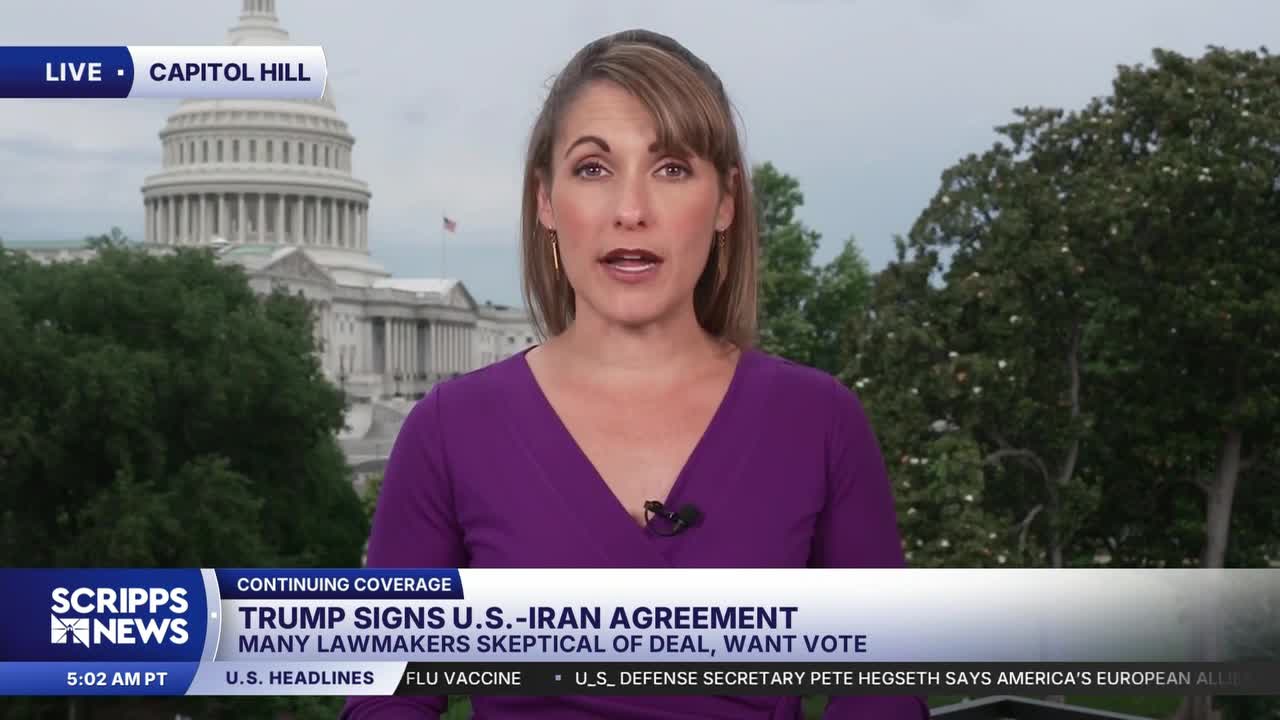


President Donald Trump is back in the U.S. after signing a landmark agreement with Iran while attending the G7 summit in Versailles, where French President Emmanuel Macron hosted a dinner Wednesday. Trump signed the agreement at that dinner, and a copy was sent to Iran, where Iranian President Masoud Pezeshkian also signed.
The deal immediately triggers several significant changes. The U.S. naval blockade on Iranian ports is set to end, and the U.S. Treasury will issue sanctions waivers allowing Iran to sell its oil internationally — a major financial benefit for the country. Shipping traffic through the Strait of Hormuz has already increased in recent days, and officials hope that trend continues as global energy markets move toward stability.
The agreement also establishes a memorandum of understanding for a $300 billion investment in reconstruction and economic development in Iran. Trump has said none of that money will come from the U.S.
However, a wide range of critical issues still must be negotiated over the next 60 days, including:
- A schedule for lifting sanctions
- The release of frozen Iranian assets
- The future of Iran's nuclear program, including what happens to highly enriched uranium Iran already possesses
- Whether Iran's nuclear program can continue for civilian or energy purposes
- Who will monitor compliance
Senior White House administration officials have cautioned that a final deal is not guaranteed, and what happens if the two countries cannot reach an agreement remains an open question.
RELATED STORY | Trump and Iran sign ceasefire agreement, including $300B for Iran's reconstruction
The deal has drawn sharp criticism from members of Congress on both sides of the aisle. Democrats have argued the agreement gives Iran a significant advantage. Sen. Richard Blumenthal said it puts Iran in a better position than it was before the war started at the end of February.
"This agreement must come to Congress. Anybody advocating for it is going to need flame-resistant body armor, because it will meet with bipartisan condemnation when it reaches Congress, as it must do, because it has all the appearances of a treaty," Blumenthal said.
Republican critics have also voiced strong opposition. Sen. Ted Cruz of Texas said Trump is receiving bad advice on Iran and called it a mistake to give Iran billions of dollars. Sen. Bill Cassidy of Louisiana offered some of the harshest criticism.
"This is the worst foreign policy blunder in decades. It's going to leave Iran stronger. It's going to leave our allies weaker. And it may commit U.S. taxpayer dollars. Now Iran recognizes that they can use their leverage of the Strait of Hormuz to extract from the other countries of the world," Cassidy said.
Not all Republicans oppose the deal. Sen. Lindsey Graham said he sees no downside to what the president is attempting to accomplish.
RELATED STORY | President Trump says Strait of Hormuz will be 'fully opened' by Friday
Trump addressed his critics directly in a post on Truth Social, saying, "These fools who think I haven't been tough enough on Iran, when the stock market just hit a record high and oil prices are tumbling down, either are jealous, bad people or stupid."
Congressional opposition could carry legal weight if a final deal is reached. A federal law requires any agreement related to Iran's nuclear program to receive congressional approval. Preventing Iran from obtaining a nuclear weapon was one of the reasons Trump cited for entering the conflict, making the nuclear question central to any final agreement.
