

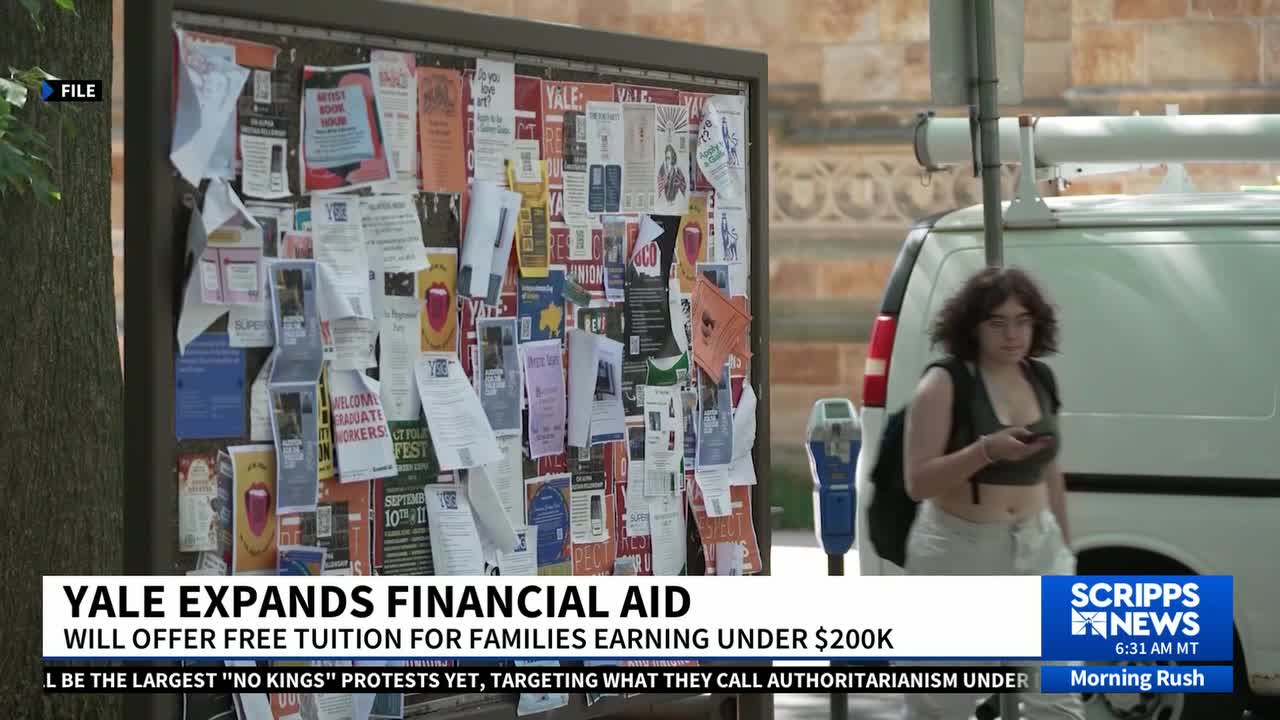


Yale University announced Tuesday it will make tuition free for newly admitted students whose families make less than $200,000 a year, starting in the 2027-2027 academic year.
The new policy will "eliminate all expected costs for families with typical assets and annual incomes below $100,000 while also ensuring that families with typical assets and annual incomes below $200,000 receive need-based scholarships that meet or exceed the cost of tuition."
The program covers tuition, room and board for those who are fully eligible. By Yale's calculations, close to half of U.S. households would be eligible for full coverage, while as much as 80% of households would have at least their tuition costs covered.
The offer is an expansion of Yale's existing "zero parent share" program, which since 2010 covered all school expenses for students from families making $65,000 or less. The program was boosted to a $75,000 threshold in 2020.
The catch, of course, is getting admitted to Yale. The school says in 2025, it received more than 50,000 applications for admission. Of those, it admitted 2,388 students, or 4.8% of applicants.
RELATED NEWS | Federal student loan repayment rules are changing in 2026: What borrowers need to know
The changes come as the U.S. Education Department prepares to make significant changes to how federal student loans are repaid.
Beginning July 1, 2026, all new federal student loans will be placed under a new system called the Repayment Assistance Program, which is income-driven and designed to simplify repayment and reduce the risk of overwhelming debt.
The department also announced in January it will temporarily delay forced collections on federal student loans. The pause applies to collection efforts such as Administrative Wage Garnishment and the Treasury Offset Program.
