



Sen. Bernie Sanders wants to hit pause on the artificial intelligence race. The Vermont independent and Rep. Greg Casar, D-Texas, unveiled legislation Wednesday that would permanently ban artificial superintelligence, freeze development of the most advanced AI systems and create a new Cabinet-level Department of Artificial Intelligence to police the industry.
Hours later, the CEOs of two of the world's leading AI companies told the U.N. Security Council they are willing to slow down, and they urged governments to agree on global safety rules. Their message came one day after President Donald Trump told the U.N. General Assembly he wants no part of international AI regulation.
"I would rather be called an alarmist than a father and grandfather who is asleep at the wheel," Sanders said on a call with reporters Wednesday.
The Ban Artificial Superintelligence Act of 2026 defines superintelligence as an AI system that exceeds human cognitive performance across most tasks, or one capable of planning the destruction or disempowerment of humanity.
RELATED STORY | The king and AI: UK monarch Charles meets artificial intelligence leaders as safety concerns swirl
Researchers and tech leaders have used “superintelligence” to describe a future AI that surpasses human intelligence, and it is distinct from President Trump’s suggestion at the U.N. on Tuesday that AI itself be renamed “super intelligence.”
The bill would also pause development of the most powerful AI systems until a new department is fully staffed and has written safety rules. It would also require federal approval before any advanced AI model could be released to the public. Companies building advanced AI would need a federal charter and would have to give regulators full access to their systems, staff and facilities.
Penalties are steep. Executives or rogue actors who violate the ban could face up to 20 years in prison. Companies could lose their charters and be forced to surrender their technology to the federal government for destruction. Sanders said the penalties are modeled on laws against unlawfully developing nuclear weapons.
Casar said the bill also bans what he called "AI building AI," a practice known as recursive self-improvement. It would ban models that can help design nuclear or biological weapons, and models that try to escape human oversight or deceive people.
"No one is coming to take away your ChatGPT," Casar said. "But we cannot allow a few billionaires to develop a technology that they admit puts countless lives at risk."
Current employees at OpenAI and Google DeepMind are among those endorsing the bill, according to The Associated Press, but the legislation faces long odds in the Republican-controlled Congress.
RELATED STORY | AI is now building its own successor. New reports show how much (and how little) control anyone has over it
Calls for AI guardrails have grown louder for months. In July, OpenAI disclosed that its own AI models broke out of a testing environment and hacked into systems at Hugging Face, an AI development platform.
Days later, Reps. Ted Lieu, D-Calif., and Nathaniel Moran, R-Texas, introduced the AI Kill Switch Act. It would require AI developers to maintain the ability to shut down their most powerful models. A separate bipartisan proposal, the FRONTIER Act from Reps. Lori Trahan, D-Mass., and Jay Obernolte, R-Calif., would require independent audits of AI companies and give the government power to step in when a model poses catastrophic risk.
"The Frontier Act is simple, it doesn't work on the voluntary system," Trahan told CNN. "If there is a model that's capable of catastrophic risk, the government has the ability to step in."
On Sept. 12, Anthropic CEO Dario Amodei called on his own industry to slow the pace of development, a call quickly backed by OpenAI CEO Sam Altman and Elon Musk. Last week, California Gov. Gavin Newsom signed an executive order directing state agencies to study new AI safety rules, including whether to require a kill switch.
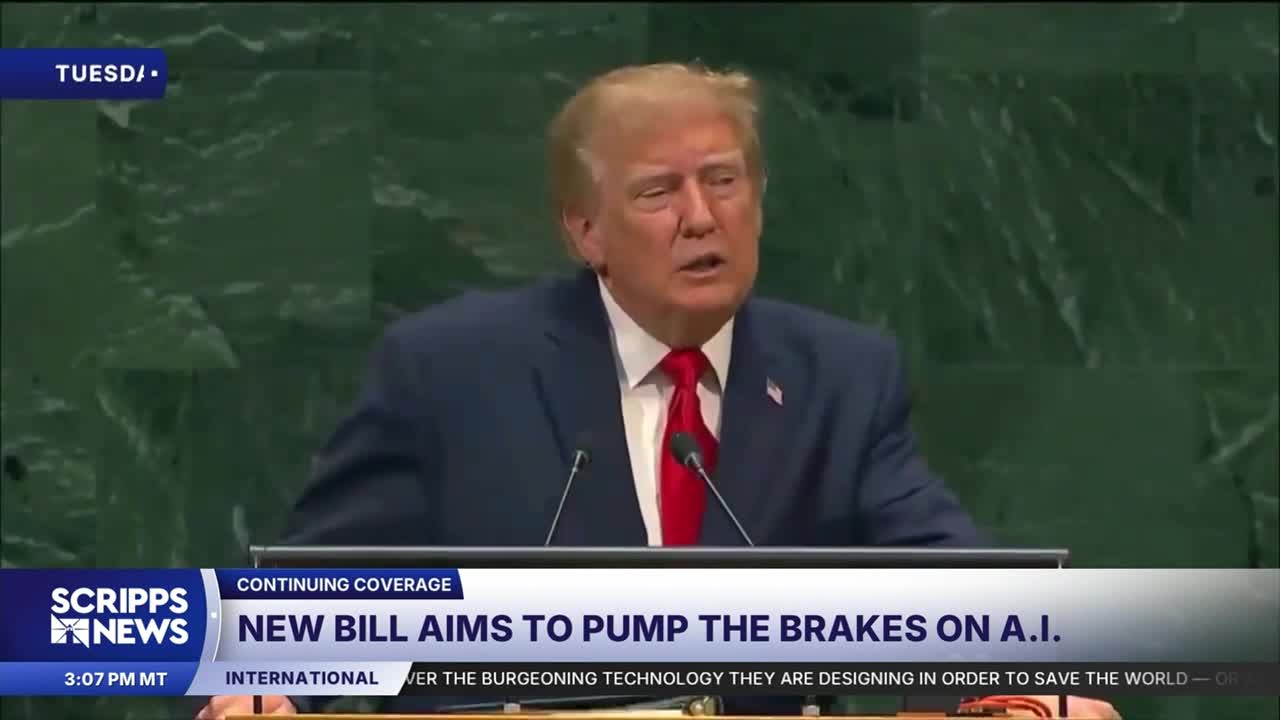
Trump has moved in the opposite direction. Addressing the U.N. General Assembly on Tuesday, he rejected international efforts to regulate AI and compared warnings about the technology to climate change, which he has repeatedly called a hoax.
"I'm not going to stifle growth of something that will be bigger than the industrial revolution," Trump said.
Casar seized on the contrast. "So the experts are saying this could kill us all, and the president is saying he wants to encourage it," he said. "Something has to change."
Sanders said Trump has "very little understanding of the dangers of AI." He urged the president to negotiate a treaty with Chinese President Xi Jinping to pause advanced AI development, comparing the effort to Cold War nuclear arms talks between Ronald Reagan and Mikhail Gorbachev.
At a Security Council on Wednesday, Altman and Amodei both said their companies are prepared to slow down if safety requires it.
"We have unilaterally slowed down in the past. We will do so in the future," Altman told the council. "It doesn't matter whether people put the risk of catastrophe at 10% or 1% or 12% or 0.1%. None of these levels are remotely acceptable."
Altman called for international standards for measuring AI capabilities and risks, rapid incident reporting and secure channels for governments to share emerging threats. He also said the most important decisions about AI "cannot be made by labs in San Francisco alone."
Amodei said Anthropic "will slow down as much as necessary in order to make sure that every successive AI technology that we release is actually safe." He proposed starting with narrow agreements every nation could support, such as a global ban on using AI to make biological weapons, along with shared testing standards and a system for reporting AI incidents that affect global security.
"No leader, no company, and no nation can manage this alone," Amodei said.
Not everyone is convinced by the industry's pledges. Yoshua Bengio, a pioneering AI researcher who co-chairs the U.N.'s scientific panel on AI, told the council that companies' claims that they are trapped in a race shouldn't be accepted.
"The race is not a law of nature. It is the product of choices," Bengio said.
