

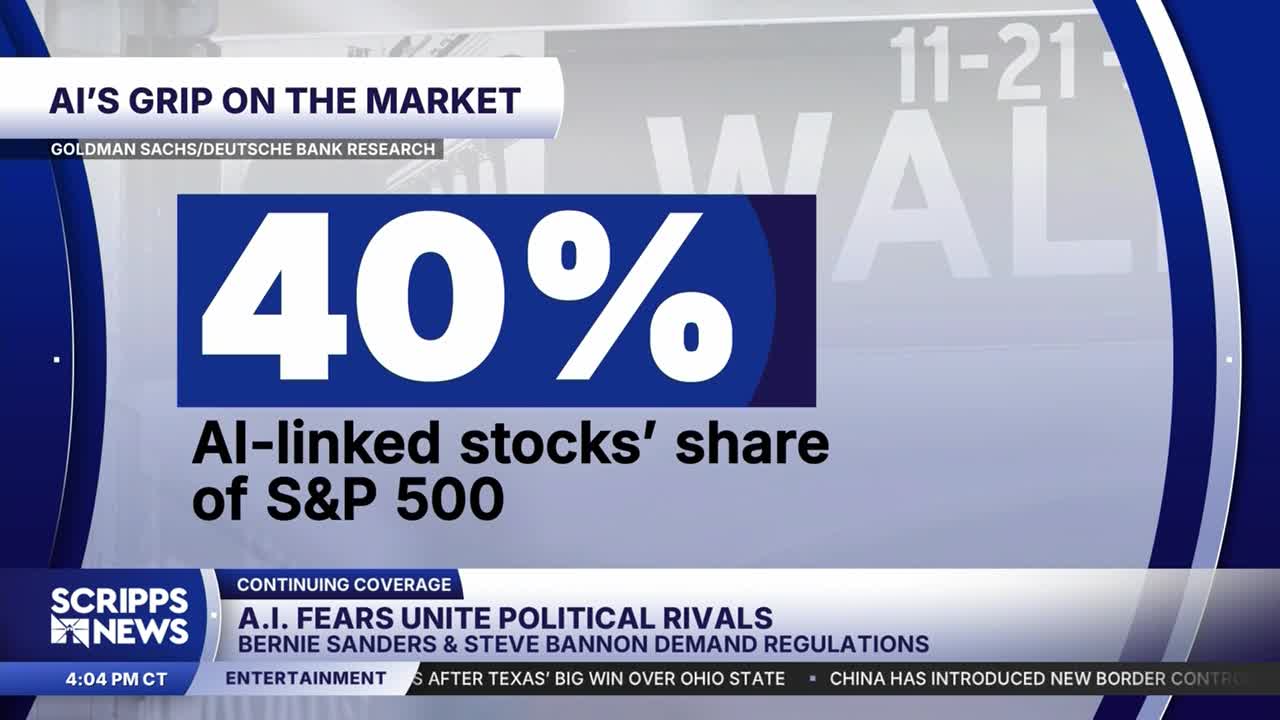


Sen. Bernie Sanders (I-VT) and Steve Bannon, a former White House chief strategist under President Donald Trump, do not tend to agree on much. But Tuesday, standing on the same stage in Washington, they agreed on this: artificial intelligence, left unchecked, is dangerous and Washington is not moving fast enough to rein it in.
The two spoke back-to-back at the "Pro-Human Assembly," a Washington event organized by the nonprofit Future of Life Institute and built around its "Pro-Human AI Declaration," which calls for keeping humans in control of AI development and holding companies accountable for the technology's harms.
"AI is advancing exponentially every single day," Sanders told the crowd.
Bannon, addressing the same audience, said he agreed the technology could be transformative but drew a hard line: "We think it could be a great technology, but we're not going to give these guys carte blanche."
The pairing reflects how thoroughly AI has scrambled traditional political alliances. Sanders, an independent and self-described democratic socialist, has spent the past year warning that "AI oligarchs" are racing to automate away American jobs without regard for the consequences. Bannon, a longtime Trump ally and host of the "War Room" podcast, has spent roughly as long warning his own audience that unregulated AI amounts to a handoff of national power to a handful of unaccountable tech executives.
RELATED STORY | Senators from both parties question OpenAI on breach of AI startup Hugging Face
On stage, Bannon went further, accusing AI companies of trying to "cover up the danger" of their own products and using the current wave of concern to entrench their market position.
"All they're trying to do is use a crisis and turn it to their advantage by creating a moat, a cartel," Bannon said. He argued the companies calling for safety rules want to "socialize all the risk" while keeping the financial upside for themselves.
Where the two diverge is on the fix. Sanders used his remarks to announce plans to introduce legislation with Rep. Greg Casar, D-Texas, permanently banning the development of artificial “superintelligence,” or AI systems capable of outperforming humans across the board. "Like nuclear weapons, artificial superintelligence is a threat to humanity, and it must be treated as such," Sanders said. "This legislation will put an immediate pause on advanced AI development until we have clear safety rules in place, developed by the most knowledgeable scientists in our country."
Sanders also called for binding international standards rather than voluntary industry commitments.
"When you're racing toward a cliff, you don't just ease the gas pedal; you hit the brakes," he said. "We need binding international safety rules, not voluntary standards from the industry."
MORE ON AI | Anthropic says it blocked possible attempts to use AI to develop bioweapons
Bannon, by contrast, argued the fix shouldn't wait on Congress at all. "We need time," he said.
"This is not legislation; this has to be executive action,” he said, framing his preferred approach as pressuring Trump to act unilaterally, alongside what he has separately described as "quarantining" China while the U.S. builds out its own rules.
The two men were among a broader, ideologically mixed lineup that organizers described as evidence of genuine bipartisan alarm. Other speakers included Sen. Marsha Blackburn, R-Tenn.; Sen. Richard Blumenthal, D-Conn.; Rep. Chip Roy, R-Texas; American Federation of Teachers President Randi Weingarten; and religious leaders including Catholic Archbishop of San Francisco Salvatore Cordileone.
