

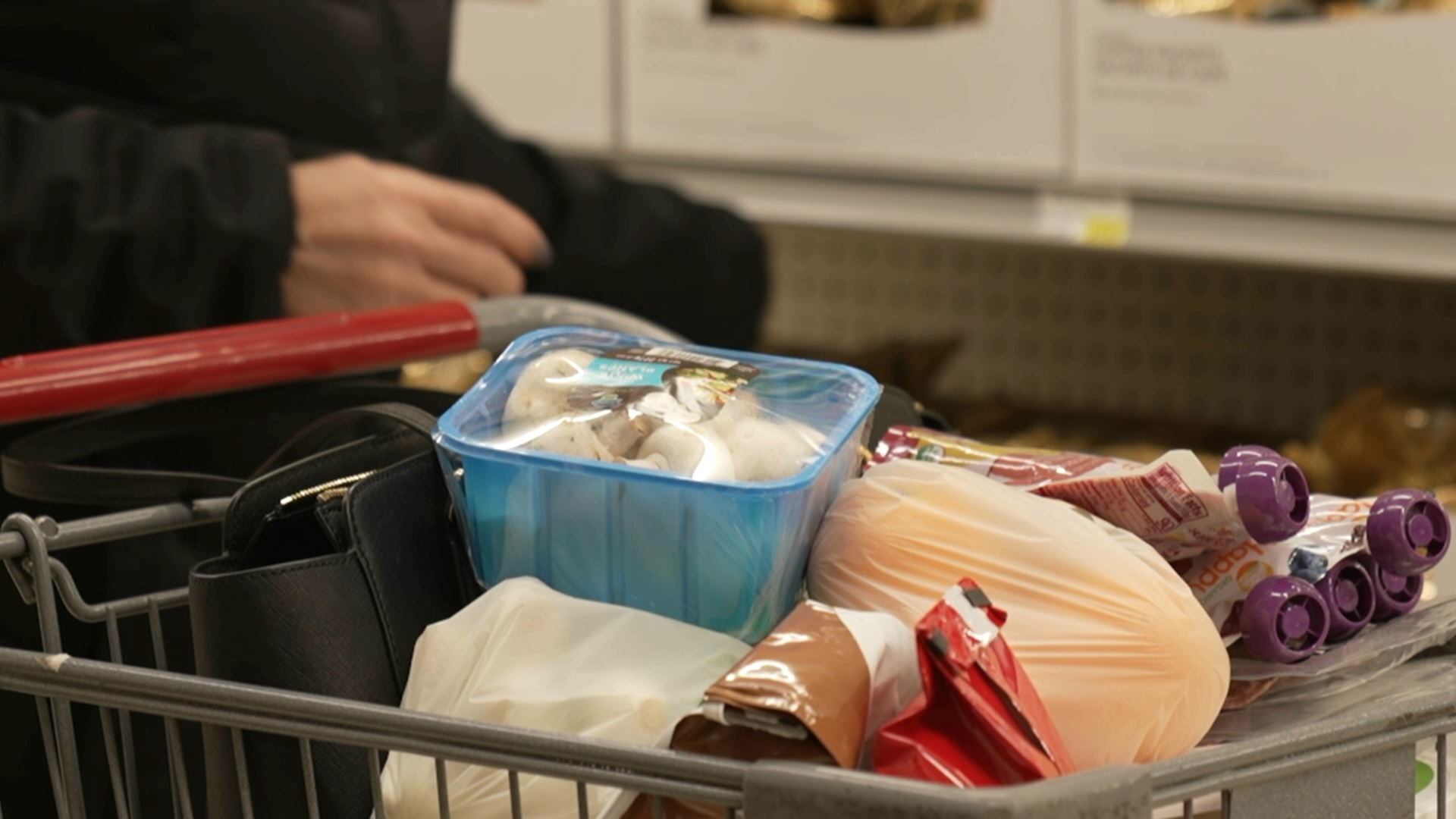


Grocery prices remain one of the biggest financial stress points for Americans, even as inflation data shows prices leveling off.
The government's consumer price index shows that grocery prices were flat from July to August and up just 2.2% from a year ago. But that stability is not translating into relief at the checkout line.
"Grocery is the thing we buy most often, right? It hits our wallet and our time every single week," said John Laramie, founder of the price comparison tool CartHappy.
Research by Motley Fool Money found the average American household spent $677 a month on groceries in 2025 — up 31% from 2019, or about $160 more each month than before the pandemic.
RELATED STORY | Shoppers are turning to international markets for deals on grocery staples
Jack Caporal, research director at The Motley Fool, says spending more does not necessarily mean more food at home.
"Some people will substitute in and out items that are a little bit cheaper in order to maintain their same level of spending," he said, "or they'll buy the same products, but they'll buy less of it to keep costs down."
Didn't retailers drop prices?
Some retailers, most notably Walmart, lowered prices on hundreds of items over the summer. But experts say those savings only benefit consumers who buy the same discounted products each week. And they don't expect the savings to last.
"Some of them are being funded by tariff refunds, and that is a one-time infusion of cash, so there's no guarantee that those cuts will be long-term," Caporal said.
Laramie agrees a handful of price cuts do not change the broader picture.
"A round of price cuts from one retailer is a real welcome data point. But it's a moment inside of a market that is wildly volatile on a day-to-day basis," Laramie said.
How technology can help find lower prices
Many of the factors driving food prices — from weather and livestock supply to tariffs — are outside shoppers' control. That's where shopping tools can help.
CartHappy, an AI-powered browser extension, helps shoppers compare prices and apply coupons automatically as they shop online.
"We'll tell you that, 'Hey, you do have the best price and it's not worth going somewhere else.' Or, 'Hey, you could go save 10, 15, 20% by splitting to two retailers or three retailers,'" Laramie said.
RELATED STORY | One in five Americans are using their personal savings to pay for groceries
Grocery shopping for many consumers is habitual – shopping at the same store on the same day every week. But Laramie points out that prices are constantly changing, and staying on top of those changes is a challenge.
"This is the gap that CartHappy exists to close," he said. "It's sort of turning that velocity into savings and helping consumers understand when and where to buy a product or their overall cart on a day-to-day basis."
Where prices go from here
The latest food price outlook from the USDA forecasts that grocery prices could rise about 2% in 2027. But the agency says there is still a wide range of possibilities — from a 5% drop to a 10% increase — underscoring just how unpredictable food prices remain.
Motley Fool Money recommends the following strategies to help offset rising costs:
- Applying for a grocery-focused rewards card
- Using budgeting apps
- Substituting items based on price
- Finding recipes that rely on cheaper or discounted items
- Looking for costs your household can trim outside your grocery budget
