



Thousands of college seniors are preparing to walk across the stage in the weeks ahead — but the excitement of graduation is quickly giving way to anxiety about what comes next.
The unemployment rate for recent college graduates hit 5.7% in the fourth quarter of last year, a four-year high. And the Class of 2026 faces a similarly daunting outlook.
"I'm excited. I'm very much anticipating the next steps, but I'm also, you know, the natural nerves that comes with like, 'What is next?'" Kyra Afolabi said.
RELATED STORY | Burnout and rejection stall job searches for millions of Americans, survey finds
Afolabi spoke with Scripps News Group before receiving her diploma last year and before she eventually secured a job.
Laura Ullrich, Director of Economic Research at Indeed, said the environment has not improved much for this year's graduates.
"We remain in a low-hire, low-fire environment," Ullrich said. "I think for the graduates of 2026, they enter a labor market that's very similar to the one that their peers who graduated last year in 2025 are entering."
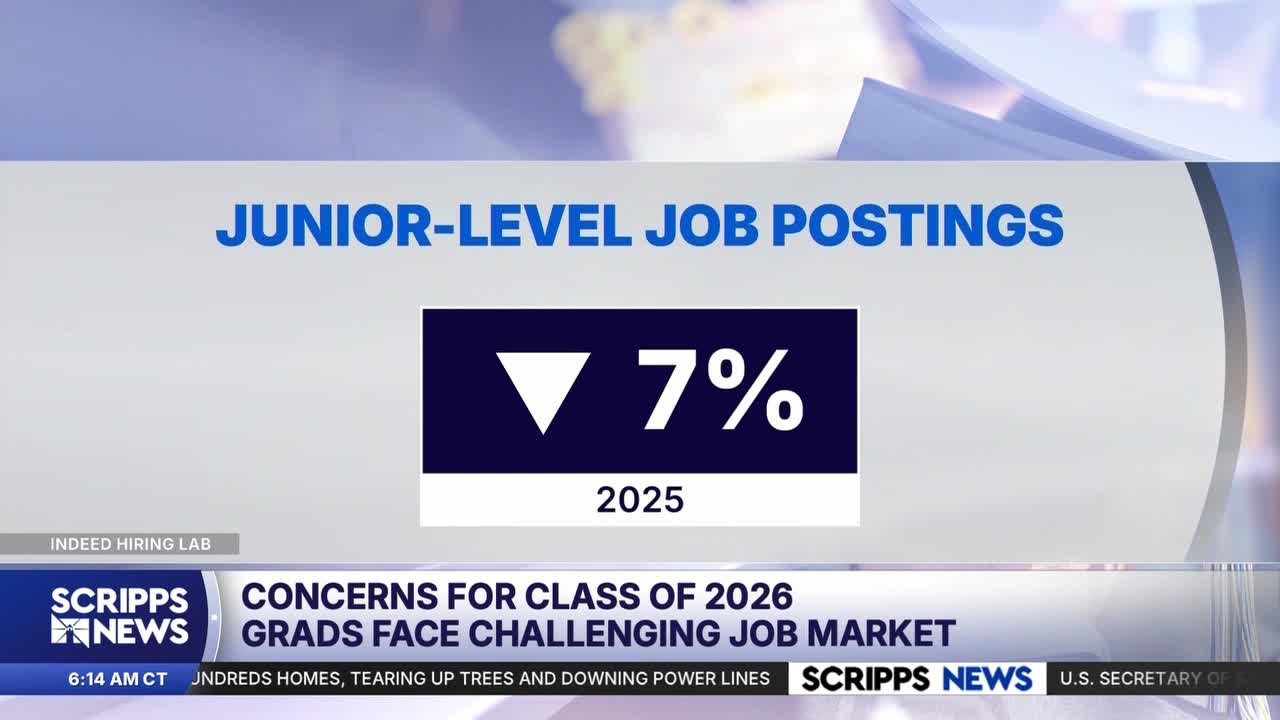
Recent graduates are doing all they can to break into the workforce. The share of graduates creating Indeed profiles online nearly doubled in 2 years, jumping to 19% in 2025. But job postings are not keeping pace with the growing labor pool. Junior-level postings fell 7% last year.
RELATED STORY | Andrew Yang predicts AI could eliminate half of white-collar jobs
"The number of jobs that are available to new grads is maybe less than they would have hoped a few years ago," Ullrich said.
Beyond the numbers, a rapidly changing work environment is adding another layer of uncertainty. Artificial intelligence is reshaping the job market before many graduates have even entered it.
"We're in this period of economic uncertainty, and AI plays into that. A lot of organizations are not necessarily removing jobs based on AI, but kind of hitting the brakes a little bit," Keith Spencer, a career expert at Resume Now, said.
Nearly 9 in 10 graduates are worried artificial intelligence will replace entry-level roles. And just 1 in 3 say college is preparing them to use AI in the workplace.
That concern is pushing some students toward careers seen as more resistant to automation. Chris Stone is among those learning skills like welding at a community college.
"I feel like we definitely help our community with producing good quality welders," Stone said.
Vicki Salemi, a career expert at Monster, said trades and frontline roles may offer more stability for job seekers worried about AI.
"There are certain jobs that are more AI-proof than others, and they're more along the lines of frontline workers in terms of mechanic, electrician, plumber, a nurse," Salemi said. "So those are the jobs that may have more viable prospects if job seekers are looking something that they're concerned about AI replacing their job."
While AI is causing concern for graduates looking to secure a job, many are also using it to land one. A survey found nearly 40% of graduates are using AI tools in their job hunt.
