

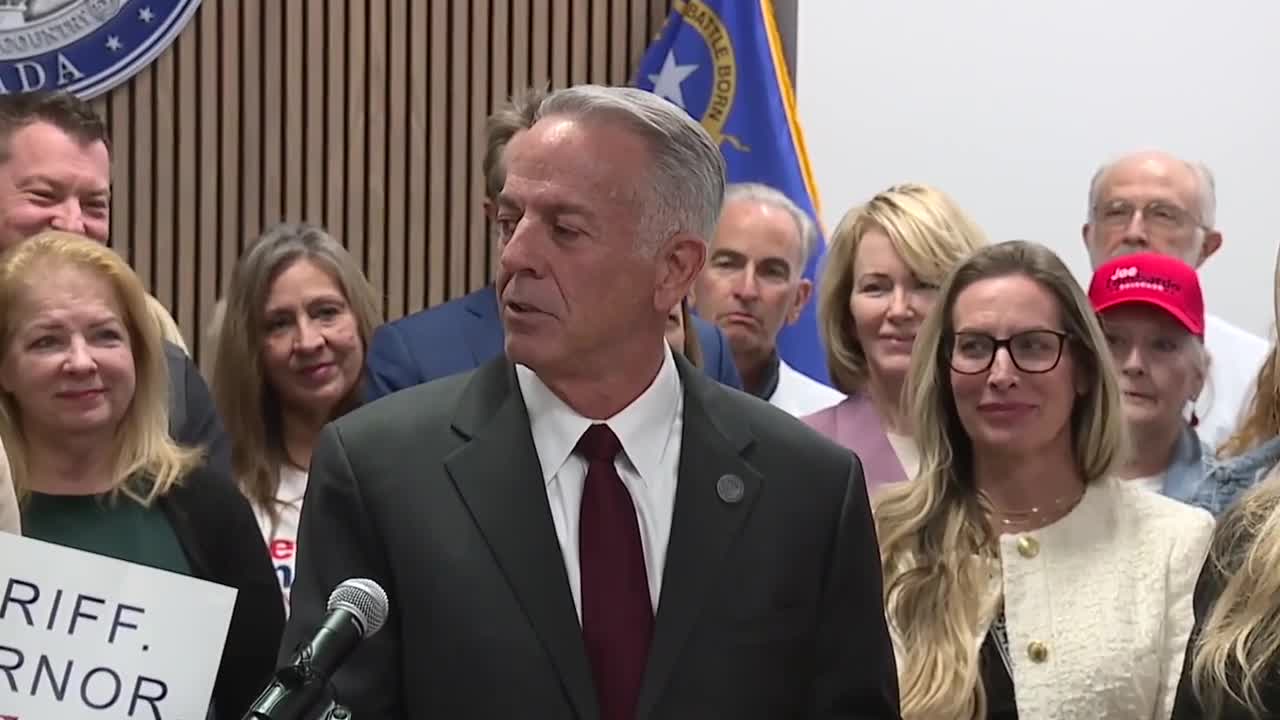


LAS VEGAS (KTNV) — Gov. Joe Lombardo on Friday signed an executive order to put regulations on new data centers in Nevada, forcing them to pay sales taxes that go toward K-12 education.
The order comes in the midst of an ardent ad war between Republican Lombardo and his Democratic rival, Attorney General Aaron Ford. Both have accused each other of capitulating to data centers, which have become controversial with the rise of artificial intelligence.

Local News
'Play by our rules': Lombardo signs executive order to regulate data centers
Lombardo's office did not make the governor available for an interview, but his office did issue a statement saying the executive order was issued to address public, not political, concerns.
"Governor Lombardo took thoughtful and decisive action in response to Nevadans demading answers about how data centers will operate in our state," the statement reads. "Beginning today, Nevada now has predictable guardrails that make data centers responsible for protecting the communities they serve. Nevadans shouldn't have to wait to resolve these critical issues.
"There is one person in the state of Nevada who has the authority to deliver these reforms and demand accountability from data centers — and that is Governor Lombardo," the statement adds. "Waiting for the legislature to get this right is never an effective strategy. Nevadans expect their leaders to step up, take action, and deliver on their promises, and Governor Lombardo answered the call."
Under the executive order, new data centers in Nevada:
- Must pay the 2.6% portion of the state sales tax that goes to schools, known as the Local School Support Tax. Currently, data centers can get an exemption from that tax, which has cost the state about $357 million between 2015 and 2026, according to the Clark County Education Association.
- Must meet water standards for the area the center is located in. In Southern Nevada, that means complying with a ban on evaporative cooling systems.
- Must bear all the costs of electricity service, including power generation and grid capacity, so no current ratepayer pays more as a result of the need to serve data centers.
- Must not use power during a power grid emergency that's needed by homes or existing businesses.
- Must sign a community support commitment that outlines benefits to the community.
WATCH | Gov. Joe Lombardo issues executive order on data centers
The executive order language is consistent with a June op-ed Lombardo authored in the Reno Gazette-Journal, in which he said "it's our paramount responsibility to ensure that these projects never burden ratepayers, resources or Nevadans, and that these projects always serve our state's long-term interests."
In that same op-ed, Lombardo lauded the construction jobs, permanent data-center jobs, tax revenue and other benefits data centers bring, adding "with these safeguards in place, we can ensure Nevadans are benefiting from data center development without negatively impacting our everyday lives."
Political controversy
But Ford has attacked Lombardo for going too easy on the industry, noting that he's received more than $1 million from data center developers. The state has handed out $240 million in tax abatements to the industry, Ford claims in a TV ad.
Lombardo has countered that it's Ford who's responsible, since he co-sponsored the 2015 bill that authorized data center development in the first place. (That bill, Senate Bill 170, had bipartisan support and passed the state Senate unanimously, with just six Republicans dissenting in the Assembly.)
Ford has said the data center environment has changed considerably since 2015, with the explosive growth of artificial intelligence and the need to build scores more data centers than existed 11 years ago.
He criticized Lombardo's executive order as a political move designed to blunt criticism of the governor's support for data centers.
"He's trying to backtrack, but it's ineffectual in this instance." said Ford in an interview with Channel 13. "I would say it's weak, entirely ineffective and it certainly doesn't respond to what I'm hearing in the communities that are the primary concerns."
Governing bodies from Boulder City to Reno to Henderson to Pahrump have wrestled with whether to issue permits to data centers in the face of widespread, and bipartisan, public opposition to the plants.
Ford said, if elected, he would suspend all data center tax breaks while an audit is done to see if the tax breaks have produced the intended benefit. In addition, he said local governments should have veto power over whether data centers are allowed, and they should be required to purchase green power in order to operate.
Ford also said data centers shouldn't be allowed to raise utility costs for residents, and that they shouldn't burden local water systems.
"Joe Lombardo thinks that Nevada voters are stupid," Ford said. "He doesn't think that they can see through this charade that he's putting out there right now. The facade that he's actually interested in regulating data centers when he has himself, in his own words, said that he wholeheartedly supports them."
Industry response
Tray Abney, executive director of the Nevada Data Center Alliance, said the group had no problem with the contents of Lombardo's executive order.
"I think it makes sense," Abney said of the order. "We know that it's important that the data center developers, data centers, pay for their own power, make sure there's no water used in this arid environment, make sure that they don't have any kind of negative impact on their community whatsoever. So we think this makes a lot of sense, and understand that schools need their funding, so we are supportive of what the governor is trying to do."
Abney — a longtime government affairs player in Carson City — said he's been surprised by the response to data centers, which has grown quickly in recent months.
"I have never seen something hit so hard, so fast and grow so fast and be so emotional and vitriolic as I've seen data centers," he said.
Abney acknowledged anxieties over things such as A.I. eliminating jobs, A.I. agents going rogue and operating independently from their creators, and the use of surveillance programs such as Flock cameras.
But he said some opposition to A.I. is ironic.
"It's fascinating to me when you have people come up to the dais or come up to the public comment desk, and they're reading their anti-data center screed off their phone, while their words are being transcribed by Wordly, and being transmitted across the world on YouTube," he said.
Abney said while his group would embrace some regulations, it would oppose removing the tax incentives entirely, or a moratorium on building new data centers.
He said the matter will be a topic of debate at the 2027 Legislature, which begins in February in Carson City. Already, several lawmakers and other officials — including Ford and state Sen. Nicole Cannizzaro, who is running for attorney general — have requested bills to be drafted on data center regulation.
"You're talking about an industry that could actually bring a lot of money into a local economy without a lot of services, right?" Abney said. "So let's be very thoughtful before we just go along with the Facebook mob and say no, no payments whatsoever."
Do you have a question about Nevada politics? Ask Steve at Steve.Sebelius@ktnv.com, or by clicking on the banner below.

