

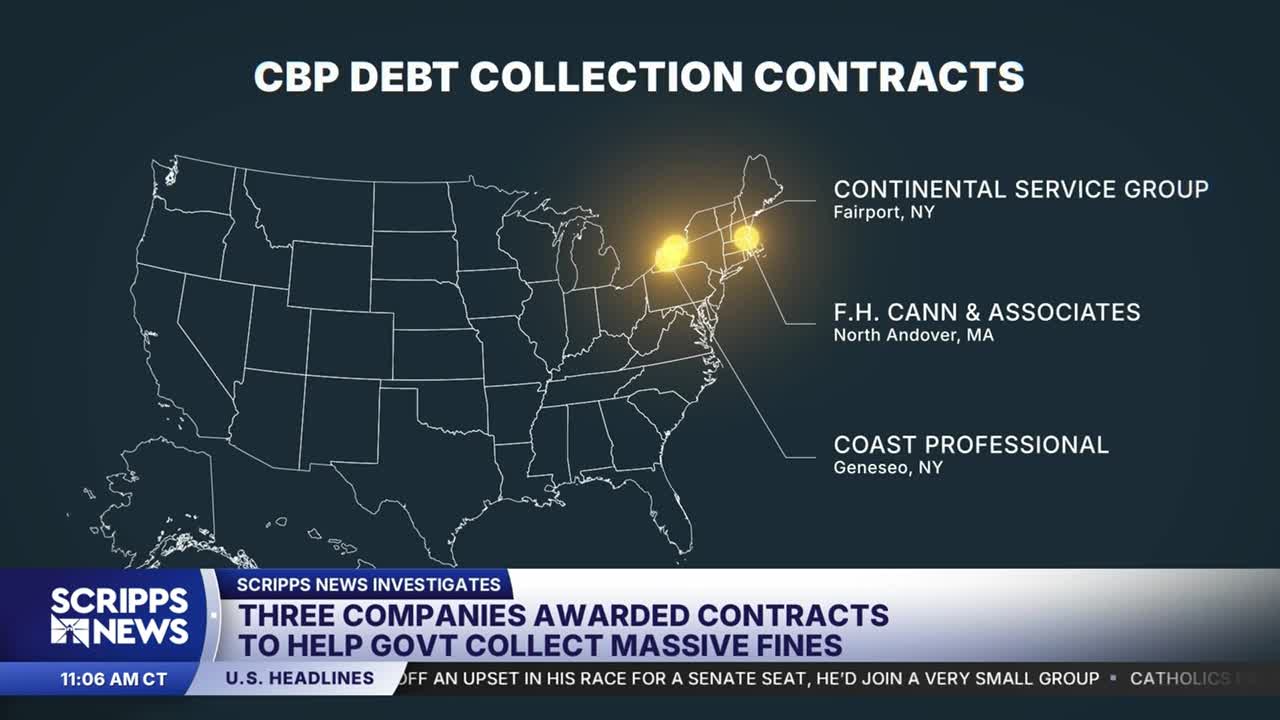



Private debt collectors are helping the Trump administration impose massive civil penalties on immigrants accused of being in the country illegally as a way to encourage them to leave on their own.
The ongoing Scripps News ICE Inc. investigation found the companies are able to profit off both the tax dollars awarded to them in government contracts and in steep fees they are tacking onto fines that few migrants are actually paying.
A $1.8 MILLION FINE
About a year ago, a piece of paper arrived in the mail that would splinter 22-year-old Eric Amaya’s family.
It was a notice from the Department of Homeland Security saying Amaya’s father owed $1.8 million for ignoring a deportation order from 1996.
Federal law allows DHS to fine immigrants $998 each day they stay beyond an order to leave the country for a maximum of 5 years, equaling $1.8 million.
“It’s insane, right?” Amaya said. “No one can pay that amount of money.”
RELATED STORY | ICE awards contracts for companies to visit homes of child immigrants
The surprise notice led Amaya's father, who Scripps News agreed not to identify by name, to believe he had become a target for deportation. He decided to move to his native El Salvador rather than risk arrest and prolonged detention by ICE, his son said, leaving his family behind in Maryland.
“He said to us that if he stayed, he felt like he was going to die,” Amaya said. “My father suffers from a heart condition. He suffers from heart failure.”
The ongoing Scripps News ICE Inc. Investigation has exposed repeated complaints about inadequate health care among detainees at for-profit immigration lockups around the nation.
THREE COMPANIES AWARDED CONTRACTS
The Amaya family’s experience is part of a much broader effort by the Trump administration to collect immigration fines allowed under federal law but rarely enforced during previous administrations. After Eric’s father left the country, the notices kept coming.
Scripps News has learned that Customs and Border Protection has awarded at least three contracts to private collection agencies to pursue immigration-related debts. One of the contracts went to Continental Service Group or ConServe, a debt collector that sent a bill to Eric’s father.
“They know that they can outsource some of the immigration enforcement functions to private markets in order to scale the scope of the intimidation tactics,” said Charles Moore, a staff attorney at Public Justice, a group representing immigrants in court who are fighting the fees. “If they get private companies who are incentivized by making money from the government, they can target even more people.”
In addition to the hundreds of thousands of tax dollars in the contracts, CBP is also allowing these private debt collectors to charge huge fees.
The bill Amaya’s father received from ConServe added more than $500,000 in administrative costs and more than $60,000 in penalties, according to the bill reviewed by Scripps News.
“You just chalk it up to the rest of the numbers you’ve seen as, okay, it’s ridiculous,” Amaya said.
IN CASE YOU MISSED IT || ICE locking up more parents and children at for-profit detention center in Texas
CBP confirmed ConServe gets to keep at least some of those fees.
“The private collection agency retains funds for administrative costs, interest, and late payment penalty,” an unnamed CBP spokesman said. “CBP supports efforts to ensure that individuals meet their legal obligations, including payment of immigration-related fines and other debts owed to the U.S. government.”
CBP says those who voluntarily leave the country using the CBP Home app will have their fines forgiven.
“Not only are the fines forgiven, but illegal aliens receive a free flight home and an exit bonus of $2,600,” a CBP spokesperson said in a statement.
But the government plans to seek payments from more than 66,000 immigrants who have already left the U.S. and are now in Guatemala, Honduras or Mexico, according to contracting documents.
Few immigrants appear to be paying the fines, according to data provided by DHS.
As of July 16, ICE had issued more than 103,000 civil fines totaling more than $84 billion but had collected only $1.2 million.
THE IMPACT
Moore said CBP is sending bill collectors after some immigrants who should not be subject to civil penalties, a claim the government disputes.
“Those are folks who are seeking lawful status, who have orders of supervision with ICE or have some other reason to remain in the country,” Moore said. “The point of all of this is to scare people.”
That fear comes across in declarations filed by immigrants in federal court.
“I live in panic due to this fine,” wrote one person going by the initials A.S. “The fines have made me afraid to live. I am trying to be like a ghost so nobody sees me.”
In another declaration, an immigrant says “It is so much money and I can never pay that. I could not sleep or eat or concentrate at work. My oldest child, who is 10 years old ... she cried and stopped going to school for a week and did not want to eat.”
MORE FROM OUR ICE INC. INVESTIGATION | 'Mom, what did we do?' Parents recall weeks in ICE family detention
CBP issued a fine for more than $900,000 to a woman who came to the U.S. from Guatemala to escape domestic violence.
“I’ve had days when I don’t sleep, thinking that at any moment they can knock on my door, arrest, me, leave my children alone,” she said in an interview with Scripps News. “I couldn’t pay off all that money even with my whole life.”
Eric Amaya graduated this year from college with his bachelor's degree. In a video taken of the ceremony, he is seen on the stage telling his parents he loves them.
His father had already been back in El Salvador for months. With fees, he owes $2.4 million.
“The hope is that my father comes back one day,” Amaya said. “My father was the primary breadwinner of the family. His income alone paid for the mortgage and the food. I find myself having to work more and to face all of those charges by myself now.
“I find my journey being more difficult without my father here,” he said.
